Discover Karen’s inspiring journey from professional athlete to devoted mom, showcasing resilience and positivity during life’s challenges.
I met Karen in 2023 at LA Fitness in Seattle. She would frequent my weekly yoga and mat Pilates classes I taught there. Karen stood out to me right away. She is someone that just exudes inner beauty with her kindness towards others, her contagious smile, and uplifting positive energy. I always looked forward, and still do, look forward to seeing her in class!
Karen has had a lot of change over the past several years! I met her in a pivotal time of her life not to mention it had just been Covid where borders were closed and she was obliged to stay in Seattle! When I met her I learned that she had been a professional Ultimate Freesbie player for Colombia. She had recently suffered a knee injury requiring ACL and meniscus repair, and was in route to business school in Canada but was unable to attend University due to borders being closed at that time. Karens ability to stay positive and focus on opportunities instead of what could have been is inspiring and uplifting! Thank you Karen for sharing your positive energy and ‘go get em attitude’ with me and everyone you meet!
Karen is now living in Seattle indefinately, as she found love, got married, and became a mom! She has 3 stepsons and a daughter, Mille, who is almost 2! When she is not at Le Bureau she enjoys practicing and watching sports, reading and watching true stories, and of course being a mom!:)
“I met Brooke over three years ago when I was recovering from a knee surgery. Under Brooke’s guidance in both yoga and Pilates, I have grown physically, mentally, and spiritually. She has the unique ability to connect with everyone in the class, to meet each person where they are at, and create a safe space for everyone to meet their potential. Every class I can attend presents me different challenges with an emphasis on breathing, stretching, and the interconnectivity of the entire body to create body and mind harmony and balance. Instead of feeling drained at the end, I always leave feeling refreshed, thinking how to improve and how I can be a better version of myself.”
Join my Pilates class to master the basics before starting your ‘100’s.’ Enhance your posture and breathing for a safer, more effective workout!
In classical Pilates the ‘100’ is usually the warm-up, which is very effective warm up of course! That said, I think it’s better to start with some basic functional movements, and spend a little time softening our bodies and releasing tension and areas of stuckness.
The above video is a glimpse of some things you can expect to do before you dive into your ‘100’s’ if you come take my Pilates mat class.
I know starting a movement class, especially if it is new to you-can be intimidating.
Taking a few minutes to notice your posture, expand your breathing, mobilize your spine awareness to all parts of your body will help was you into your workout, keep you safe, and enhance your connections!
Please join me at Le Bureau every Wednesday 9-10am! Please email me to reserve your spot.
How about in a squat or lunge position…can you find your hip hinge?
I’ve learned over the years that understanding how to hinge at my hips can make all the difference in my practice! Its empowering to experience this understanding in your body!
Understanding and experiencing your hip hinge you will also learn how your pelvis needs to participate. This understanding will further help you understand how our thigh bones drive pelvic placement! Therefore your feet and your legs need to participate and integrate start to finish. You learn how much your feet work, your legs work and the importance of unlocking your knees to connect your feet, to your legs, to your knees, to your hips etc etc. Your body therefore understands more and more that the WHOLE body participates in your movements.
As my clients progress with their Pilates practice, my hope is that they can understand more and more how their practice translates over to their day to day movements. AND understanding HOW TO HINGE at their hips is KEY. It’s never just about belly button to spine and squeezing your gluteals all the time! Its full body integration start to finish:)
Check out my Pilates mat class on YOUtube where I demonstrate and go over some hip hinging in various positions so that you can integrate the hinge in your pilates workout to enhance your day to day.
We stand every day and the simple act of standing should never be taken for granted. In fact, Joseph Pilates would often have his new clients stand for their whole session. He instructed his clients to pay attention to how they were standing to feel balanced and whole front to back and side to side, and breathe! when Joe saw that they were able to stand with this attention he would invite them to begin practicing the beginner system he created.
I find most times ‘we’ are unaware of how we stand. This lack of paying attention overtime can cause imbalance and structural/functional imbalance.
One postural habit I see a lot is the positioning of the pelvis…it shows up all the time! The pelvis often time is forward which not only causes tightness in the hip flexors and quadriceps but a lack of connection in the gluteals and hamstrings.
When this is the case, your bottom may feel like 2 squished raisons.
My hope for all of us is that our bottoms are more like 2 plump grapes than raisons:).
I believe, most times it’s building awareness in your body and being attentive to how we stand that will make the biggest impact on how we function day-to-day and move in our bodies.
Exercises can definitely help your build strength, but with everything, if they are done without attention to posture for the purpose of creating overall balance in the body, exercises can cause more imbalance and more unnecessary stress on your structure…its not what you do, its how you do it!
If you feel you have 2 squished raisons for your derrière, consider your pelvic placement when you are standing, sitting, and exercising…
Check out my beginner mat workout on YOUTube where I focus on Pelvic Placement and “standing in our body” with attention.
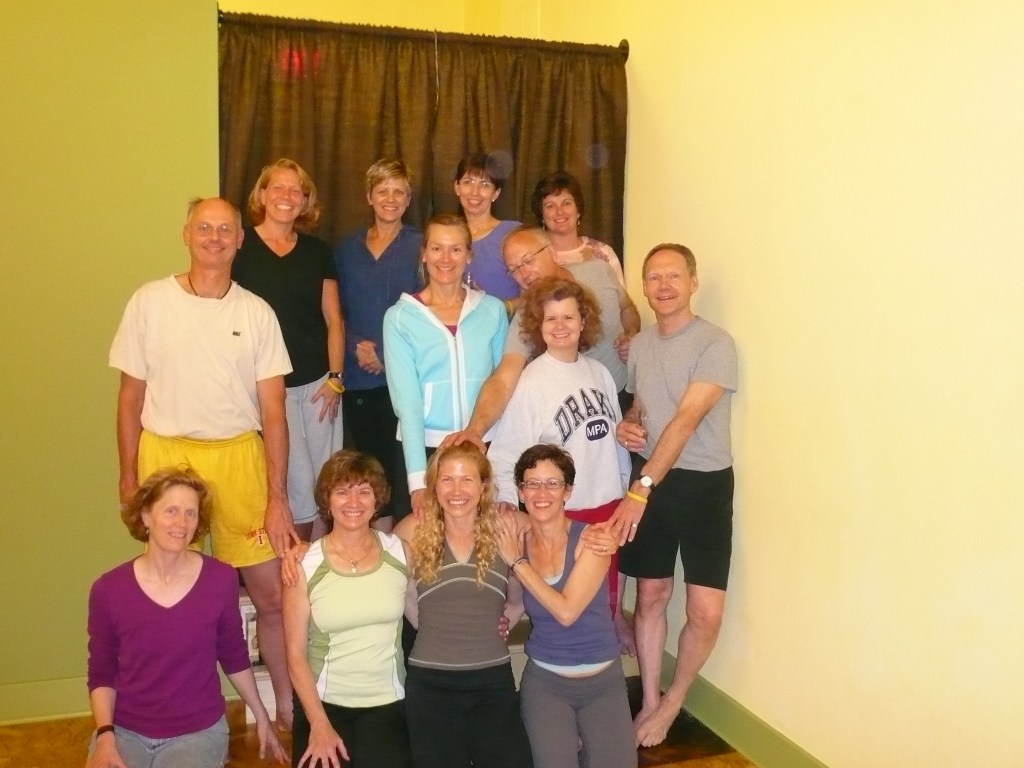
This picture was taken in 2005 at Shakti Yoga in Des Moines Iowa. It was my last class. I will always be grateful to this community and my first Anusara Yoga teacher – Brette Berlin Scott.
What makes a great teacher?
I have been reflecting on this a lot lately. I have had many teachers over the years as I have moved several times since marrying Pontus in 2003 for his medical schooling/residencys etc. Although moving around has been exhausting, especially when we started having kids (4 years after getting married), it has also been exciting and fun to start fresh, and connect to new perspectives. I have been somewhat of a gypsy, finding my people along the way with no particular place to call home.
I have been curious what sets some of my favorite teachers apart?
One thing I know for certain, it’s not just what the teacher knows, it’s who the teacher is at their core that makes him or her such a powerful influence.
I also credit my personal struggles and experiences to be some of my greatest teachers (once I started to pay attention)!
I have been a teacher for many years…
In my youth I was a nanny in college and after graduating with majors in liberal studies and French at Seattle University, I continued for another year to earn a Masters in education.
Teaching school for me was short lived! Moving around a lot, was a big reason. Although, I did get a job teaching HS French for 6 months that was temporary and substitute teaching was draining.
It was in Toledo Ohio, in 2005/6 that I decided to stop teaching school and start devoting my time instead to teaching something that filled me up with joy and inspiration. Fitness and moving my body, particularly with the methods of yoga and Pilates was exactly that…
I dove into learning and have too many courses and training to mention over the past 22 years. My goal has always been to share what I learn to help others to feel better in their body – ultimately feel better about who they are.
I was not always healthy and fit in my youth and suffered my junior year in high school. I got sick and never got better. I gained a lot of weight, experienced severe acne all over my face, and suffered a lot of shame. I learned my thyroid was hypothyroid, and have been taking hypothyroid medication ever since.
Although looking back this was a horrible experience for me, it was also one of the best things that ever happened to me as it woke me up and I started taking more ownership of my life.
So here are some of the qualities that I believe make a great teacher….
-someone who is an inspiration. Who walks the walk.
-someone who is encouraging.
-someone who is honest and truthful in who they are and what they say.
-someone who shares in their journey(we all have one) and continues to show up.
-someone that understands that everyone is different and may need a different approach and variations.
-someone who watches and listens with compassion and love.
-someone who acknowledges their mistake(we all make them).
-someone who is happy for your achievements and not jealous of what you can do.
-someone that believes in themselves and believes in you!
So what do you think? Who are some of your favorite teachers and why?
You do not need to tuck your tailbone in order to strengthen your core!
Joseph Pilates placed a strong value on understanding and connecting to a TALL back in standing exercises to help one understand proper posture. Having awareness of a TALL back posture is essential before going into any movement and especially into a round back(tucking) posture.
*in fact, it was quite common for Joe Pilates to have his clients “stand” for their whole lesson. He would encourage them to focus on their posture. When their posture was ‘good enough,’ Joe would invite them to progress with the apparatus and other exercises.
Whenever you are standing, you want to connect to a TALL back posture. A tall back is when you –
Respect the natural curves of your back. Lordotic curve in lumbar and cervical spine and kyphotic curve in thoracic spine.
Connect to a neutral pelvis(aka – not tucked) When your pubic bone is level to your hip bones on the sagittal plane.
You stack your body! Where the center of your skull lines up to the center of your ribs, lines up to the center of your pelvis, lines up to the center of your knees and finally ankles.
Posture is an action and never just ‘sits’. Meaning that, you need to be attentive and present to sustain a tall back posture:). Its takes steady presence, effort and sometimes some softening to find and maintain a well balanced posture. For me personally, I have a very flat back and my head pushed forward and down for many reasons!!. Knowing this, I focus on lifting my low back in and up, I also try to create more width and expansion in my mid thoracic spine by using my breath, and I have learned over may years to pull my throat, skull back and up which has helped me not only achieve better alignment, but consequently allowed me to build better strength in my upper back and neck.
*Most people (I observe) have super tight hip flexors (maybe from too much sitting or too much exercising and not enough stretching). Tight hip flexors will push their thigh bones forward in their hip sockets. If this is you, you’ll need to soften your knees, to draw the top of your shins forward to help you draw the top of your thighs back! Another common issue is rib flaring in the front body. To help with your ribs you need to consider expanding and breathing more into the back of your rib cage and use your exhales to connect the front ribs in and down toward the pelvis to expand the back ribs back and up.
What are you working on in your posture?
If you practice Yoga, you can think of Tadasana/mountain pose as your TALL back posture! This posture is not just ‘standing there’… On the contrary, Mountain pose in yoga is a demanding, dynamic standing posture. Although you may look still on the outside you are working hard on the inside to oragnize your body as you integrate every part of your body from your feet pushing into the earth to ground, all the way up to the crown of your head. You should feel strong and stable like a mountain, yet also light and lifted like a puffy cloud. In other words, no one would be able to come by and push you down because you are strongly rooted, buoyant and resilient connected bottom to top, top to bottom, and side to side!
Are you attentive when you stand still?
So why then do we tuck the tail bone…
In round back positions and rolling position we need to tuck the tail to help us with articulating our back bone by bone. Think of rolling-over, rolling like a ball, open leg rocker, seal on the mat or stomach massage round back, elephant, and kneeling knee stretch with a round back position on the reformer.
There are some exercises that transition in and out of round back such as the roll-up on the mat and the short spine on the reformer. When lying flat on the mat you should aim at having a neutral pelvis and when you are up in your c-curve you should have a round back where you stay slightly behind your sit bones as you roll -up. This is a subtle yet powerful awareness to build as you progress in your practice!
When we are rounding our back and our tail bone is tucked we also want to be sure our whole spine is in a c-curve so our spine is in harmony and not performing 2 separate opposing actions! Therefore, our chin should be at our chest and our gaze at our abdominals/ribs pulling and sternum pulling back and up to expand and broaden the upper spine to the lower spine. If you practice yoga, you should think Cat back not Cow back!
*I find many, including myself, have a difficult time rounding without collapsing. It is essential to keep your inner lift!
Although there are more spinal shapes (twist/side bend), the tall and round back are the 2 spinal shapes we use in the sagittal plane.
The round back is useful to teach us how to connect more deeply, to our whole spine. As a reminder when strengthening our center it involves our whole spinal body as one part will affect the other part! That is Pilates…everything is connected! Be patient and use your breathing as your guide and tool to create more width and space where your body needs it. That said when we round our back, we want to try to pull in our front body and our side bodies to support and expand our whole back side. When transitioning back to a TALL back posture (as we do several times in our pilates workouts)we should try to keep that “connection and fullness” in our back, as we reconnect to our Tall back posture.
How about the teaser?
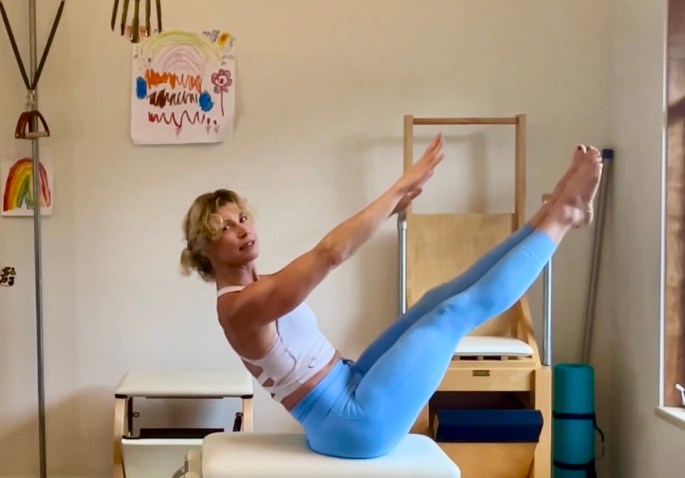
The teaser exercise is a strong and very challenging pilates exercise. Although this exercise requires a whole lot of BALANCED core strength, it also is essential that you have a flexible spine and open hips! There is a lot going on in this exercise, and it is not for everyone, especially if you have a boney tailbone…
For me personally, I have a very stiff low back and rolling up and down is tricky for me. If I move too fast, I will miss my whole lumbar spine on the way up and down. I have learned to slow down to feel more and take my time. Using my exhale will also help me cinch my waist more to help me better articulate.
This is just one scenario…There are many scenarios!! Whatever your issue/issues are – please remember it is not the destination of ‘sticking’ the posture or finding perfection – rather, it is the journey and process in how you work with your body with accepting what is first…there will always be another issue and always more work to do. Listening and paying attention to what is and making honest adjustments to support ourselves is always the best way forward…
Teaser. – Tall back or round back position?
Its actually both! There needs to be lift and length so when in your teaser position you are not dumping and collapsing in your lumbar and thoracic spine. That said there is a subtle c-curve. Meaning you will be behind your sit bones with the low back slightly rounded to support a posterior tilt especially if you are going to articulate your spine.
Careful that you are not collapsing in your lumbar spine… For example, if you are rounding too much in your low back, most cases you will be too round in your upper back and therefore not able to find your lift and length in your tall back and be able to widen your collar bone and open your chest! On the flip side, if you have too much extension and perhaps are positioned in front of your sits bones, most cases your ribs/chest will be pushing forward too much and you will not be able to connect well to your subtle c-curve and your power house muscles.
The bottom line is that there is always an element of TALL back. It is essential that you find your tall back first, especially before you round.
AND…
Remember to be gentle and patient with yourself! Pilates is not as easy as most people think. It’s sweaty hard work and always involves the WHOLE BODY. The practice of Pilates requires one to stay present and give a lot of effort! This attentiveness and hard work will increase your strength and overall well being. Any successful practice is generative:)
We get good at what we practice, not what we know:)
Check out my latest teaser tutorials on my YouTube channel!
This exercise is called ‘running’ on the reformer. Flipping the camera around you can see how this exercise reflects running, jogging, and/or walking off the reformer. I loved flipping the camera to highlight this exercise as it shows me standing tall in my body. It’s not always easy to stand tall especially if you are dealing with and or recovering from an injury. Believe me, I’ve been there! Regardless of your story, to practice Pilates, we need to include and honor all of our pieces even if things are not as they used to be, and not leave one piece behind.
Understanding how to connect and strengthen our pieces as a whole takes time and changes as we change. Listening, adapting, and continuing to love ourselves through all of our changes will be the best medicine to feel whole, time and time again. If you are stubborn like me, you may need to experience the ‘dark side’(read back in my blog to understand) for a while, until you decide to wake up and be more present!
Pilates is in the details and acknowledging all our piecesin the present moment so we can experience the whole and feel our power!!
Therefore, if you are interested in strengthening your ‘core muscles,’ understand that this involves your whole body. I have found that sometimes in ‘our’ efforts (myself included) to strengthen the ‘core muscles’ we sometimes neglect other parts of our body. Remember, Pilates is whole body integration. We need to include all of ‘our pieces’ in our practice and not forget or neglect any part! Pilates teaches us to initiate our movements from a stable, balanced center, and to never leave any part behind, meaning every piece of us is involved in the movement.
Take ‘running’ on the reformer for example, there is really so much to pay attention to! From the transition from one heel reaching under the foot bar to the next.
Here are some other things you need to consider…
1 – Are you connecting all of your toes on the foot bar or are your pinky toes missing?
2 – Are you pressing down into the foot bar with strength to feel and activate your hamstrings as you run?
3 – How is your pelvic alignment? are you tucking, arching? Hopefully you are in neutral!
4 – Are you able to connect the back of your rib cage, shoulder blades, back of skull in and up on the carriage?
5 – How is your neck alignment? hopefully neutral!
6 – Can you tone the back of your triceps to help you open the collar bone/chest more?
7 – Are you able to sustain your stability in your spine and pelvis as you lower and lift your heels with strength?
8 – Are you able to maintain your push/your strength as you resist the springs and actively under the foot bar one heel at a time? 9 – How are your knees? can you tone and lift your knee caps and quadriceps up with out hyperextending and locking your knees as you run?
10 – How about your breathing? How is your rhythm? can you expand your body on your inhales with out loosing your connections and deepen your powerhouse muscles on your exhales?
When you are learning, please be forgiving as it does take time! With steady practice and attention to your body and ALL your pieces its does start coming together, and you will start to step more and more into your POWER.
check out the song “step into you power” by Ray LaMontagne
I have recently attended a weekend Yoga workshop with Annie Carpenter in Seattle at Mother Yoga in the international district. The workshop attracted many local teachers and I am always so inspired when teachers continue to show up and keep learning. I am grateful that Annie Carpenter continues to do the work herself and shares the knowledge she’s attained over her many years of teaching. She is constantly learning and growing in her own practice. She has had to overcome her unique challenges in her own body and generously shares her experience which encourages her students to grow in themselves and give that back to their students.
Annie teaches her students how to find neutral pelvis, using the 3 planes of movement (Sagittal, coronal, transverse). It is a simple and effective way to learn and establish neutral pelvis, which is, in my opinion, so important to practice for whole body health and function. Of course once you establish this awareness of neutral pelvis and what it is and is not – it takes attention and practice to sustain it as one unravels possibly unconscious poor habits and holding patterns.
This is the practice! Paying attention to our posture to enhance our inner connections, circulation, and function in our day-to-day activities. Our bones and structures directly affect our muscles, fascia and inner organs inside to function and work properly!
I believe pelvic placement and awareness is everything as it is the center of our body and affects our whole system. Our pelvis not only connects to our upper body through our spine, but it also connects to our lower body through our femur bones. The pelvis also has 2 sides – a right pelvic half and a left pelvic half and that is significant!!
I made a short video/practice on my YouTube channel if you are interested understanding neutral pelvis where I use the 3 planes of movement. I have also started incorporating this in my Thursday mat classes:)
If you are reading this, you may already know that it is Annie’s focus on the pelvis that drew me to her and her teachings. Annie emphasizes how our femur bones drive pelvic placement, so when we work through the 3 planes of movement to balance and neutralize our pelvis, it is essential that our feet and our legs are integrating into our hip sockets though out our movements too .
As you can imagine, if we are not paying attention, the pelvis, could take many shapes and forms! It could be a combination of either tucked, arched, hiked up on one side and/or rotated too much in one direction. If you are suffering pain or discomfort in your lower back and/or hips, a misaligned, unbalanced pelvis could be to blame.
To clarify, the pelvis is going to move when we move as it is part of the spine and the legs, so its normal for the pelvis to move in and out of a neutral posture. For example, every time we walk we move in and out of tuck/tilt, hike up and down, and we rotate side to side. However, problems arise when the pelvis gets stuck in an unbalanced position and cannot unstick.
When the pelvis is imbalanced, it can directly affect the health and well-being of our pelvic floor. The following are some interesting facts on our pelvic floor to better understand why our physical alignment is so crucial.
1 – the pelvic floor is the base and the foundation of our core.
Its a group of muscles that sit at the very bottom of our pelvis, like a sling or hammock. It supports everything above it – bladder, bowel, hips and spine.
2 – the pelvic floor has openings.
For example – Women – 3
urethra
Vagina
Rectum
These muscles need to open and close at the right times to keep everything moving and working smoothly.
3 – the pelvic floor muscles should lift and lower with our breathing which is why taking deep breaths is soooo very important.
It’s a dynamic! Think of an elevator. When you breath in the elevator goes down and when you breath out the elevator goes up! A healthy pelvic floor should be able to move easility depending what your body is doing! BREATHE
4 – your pelvic floor is 70% fascia and 30% muscle.
Fascia is a stretchy connective tissue that connects our whole body like a web. It relies on the muscles to give it support, as it cannot contact on its own! When the muscles are not doing its job and the pelvis is out of alignment for whatever reason, the fascia can over stretch and as consequence can be weakened. When the fascia is overstretched it can make matters worse as the pelvic floor muscles try to work harder..it can be a vicious cycle. When this cycle continues, the pelvic floor becomes hypertonic and unable to relax as it is working overtime to compensate for the stretched out fascia. This tightness overtime leads to weakness as our pelvic floor never gets a chance to relax! This can lead to damage and several pelvic floor issues – muscle spasms, leaking, straining, inability to empty, prolapse.
I first hand understand this dynamic as I have experienced many of these consequences. Although I did not welcome any of them, they have made me a better teacher and someone that understands the importance of body alignment, especially the value in neutral pelvis!