We stand every day and the simple act of standing should never be taken for granted. In fact, Joseph Pilates would often have his new clients stand for their whole session. He instructed his clients to pay attention to how they were standing to feel balanced and whole front to back and side to side, and breathe! when Joe saw that they were able to stand with this attention he would invite them to begin practicing the beginner system he created.
I find most times ‘we’ are unaware of how we stand. This lack of paying attention overtime can cause imbalance and structural/functional imbalance.
One postural habit I see a lot is the positioning of the pelvis…it shows up all the time! The pelvis often time is forward which not only causes tightness in the hip flexors and quadriceps but a lack of connection in the gluteals and hamstrings.
When this is the case, your bottom may feel like 2 squished raisons.
My hope for all of us is that our bottoms are more like 2 plump grapes than raisons:).
I believe, most times it’s building awareness in your body and being attentive to how we stand that will make the biggest impact on how we function day-to-day and move in our bodies.
Exercises can definitely help your build strength, but with everything, if they are done without attention to posture for the purpose of creating overall balance in the body, exercises can cause more imbalance and more unnecessary stress on your structure…its not what you do, its how you do it!
If you feel you have 2 squished raisons for your derrière, consider your pelvic placement when you are standing, sitting, and exercising…
Check out my beginner mat workout on YOUTube where I focus on Pelvic Placement and “standing in our body” with attention.
Le Bureau client Spotlight – Meet John Saul, 77 years young!
He has been practicing classical Pilates for 12years.
His favorite Pilates exercises are anything that works to articulate the spine such as short spine and long spine on the reformer, and rolling stomach massage and airplane on the Cadillac.
When he’s not at Le Bureau, you can find John gardening, on his bike, or cheering for his favorite rugby team.
It’s a privilege to work with John.
I genuinely look forward to our sessions together. He shows up, no matter what, devoted to his practice, and always open to learn something new.
Thank you John for being so devoted to your practice, you inspire me to keep going and showing up for myself and the things I love to do!
“Training (running, weights, etc.) has always been the foundations I did to participate and have more fun doing other activities (rugby, climbing, hiking, kayaking). Twelve years ago, I started Pilates with Brooke. What a foundation!”
“Pilates gives me the strength and limberness for other activities. And, Pilates keeps my gut from getting out of control, despite my big appetite.”
You do not need to tuck your tailbone in order to strengthen your core!
Joseph Pilates placed a strong value on understanding and connecting to a TALL back in standing exercises to help one understand proper posture. Having awareness of a TALL back posture is essential before going into any movement and especially into a round back(tucking) posture.
*in fact, it was quite common for Joe Pilates to have his clients “stand” for their whole lesson. He would encourage them to focus on their posture. When their posture was ‘good enough,’ Joe would invite them to progress with the apparatus and other exercises.
Whenever you are standing, you want to connect to a TALL back posture. A tall back is when you –
Respect the natural curves of your back. Lordotic curve in lumbar and cervical spine and kyphotic curve in thoracic spine.
Connect to a neutral pelvis(aka – not tucked) When your pubic bone is level to your hip bones on the sagittal plane.
You stack your body! Where the center of your skull lines up to the center of your ribs, lines up to the center of your pelvis, lines up to the center of your knees and finally ankles.
Posture is an action and never just ‘sits’. Meaning that, you need to be attentive and present to sustain a tall back posture:). Its takes steady presence, effort and sometimes some softening to find and maintain a well balanced posture. For me personally, I have a very flat back and my head pushed forward and down for many reasons!!. Knowing this, I focus on lifting my low back in and up, I also try to create more width and expansion in my mid thoracic spine by using my breath, and I have learned over may years to pull my throat, skull back and up which has helped me not only achieve better alignment, but consequently allowed me to build better strength in my upper back and neck.
*Most people (I observe) have super tight hip flexors (maybe from too much sitting or too much exercising and not enough stretching). Tight hip flexors will push their thigh bones forward in their hip sockets. If this is you, you’ll need to soften your knees, to draw the top of your shins forward to help you draw the top of your thighs back! Another common issue is rib flaring in the front body. To help with your ribs you need to consider expanding and breathing more into the back of your rib cage and use your exhales to connect the front ribs in and down toward the pelvis to expand the back ribs back and up.
What are you working on in your posture?
If you practice Yoga, you can think of Tadasana/mountain pose as your TALL back posture! This posture is not just ‘standing there’… On the contrary, Mountain pose in yoga is a demanding, dynamic standing posture. Although you may look still on the outside you are working hard on the inside to oragnize your body as you integrate every part of your body from your feet pushing into the earth to ground, all the way up to the crown of your head. You should feel strong and stable like a mountain, yet also light and lifted like a puffy cloud. In other words, no one would be able to come by and push you down because you are strongly rooted, buoyant and resilient connected bottom to top, top to bottom, and side to side!
Are you attentive when you stand still?
So why then do we tuck the tail bone…
In round back positions and rolling position we need to tuck the tail to help us with articulating our back bone by bone. Think of rolling-over, rolling like a ball, open leg rocker, seal on the mat or stomach massage round back, elephant, and kneeling knee stretch with a round back position on the reformer.
There are some exercises that transition in and out of round back such as the roll-up on the mat and the short spine on the reformer. When lying flat on the mat you should aim at having a neutral pelvis and when you are up in your c-curve you should have a round back where you stay slightly behind your sit bones as you roll -up. This is a subtle yet powerful awareness to build as you progress in your practice!
When we are rounding our back and our tail bone is tucked we also want to be sure our whole spine is in a c-curve so our spine is in harmony and not performing 2 separate opposing actions! Therefore, our chin should be at our chest and our gaze at our abdominals/ribs pulling and sternum pulling back and up to expand and broaden the upper spine to the lower spine. If you practice yoga, you should think Cat back not Cow back!
*I find many, including myself, have a difficult time rounding without collapsing. It is essential to keep your inner lift!
Although there are more spinal shapes (twist/side bend), the tall and round back are the 2 spinal shapes we use in the sagittal plane.
The round back is useful to teach us how to connect more deeply, to our whole spine. As a reminder when strengthening our center it involves our whole spinal body as one part will affect the other part! That is Pilates…everything is connected! Be patient and use your breathing as your guide and tool to create more width and space where your body needs it. That said when we round our back, we want to try to pull in our front body and our side bodies to support and expand our whole back side. When transitioning back to a TALL back posture (as we do several times in our pilates workouts)we should try to keep that “connection and fullness” in our back, as we reconnect to our Tall back posture.
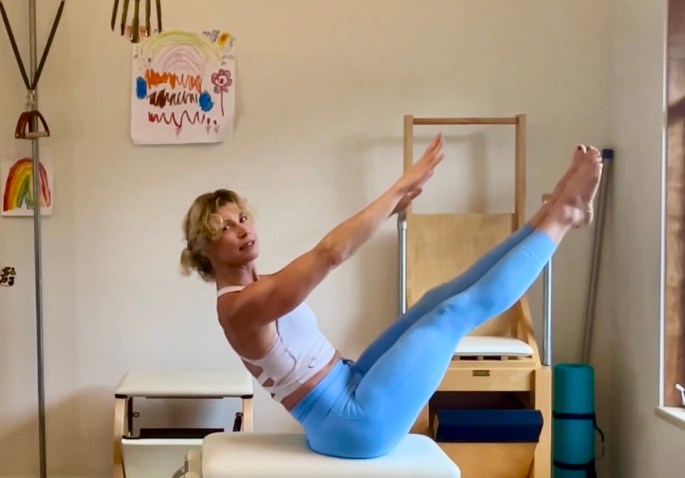
How about the teaser?
The teaser exercise is a strong and very challenging pilates exercise. Although this exercise requires a whole lot of BALANCED core strength, it also is essential that you have a flexible spine and open hips! There is a lot going on in this exercise, and it is not for everyone, especially if you have a boney tailbone…
For me personally, I have a very stiff low back and rolling up and down is tricky for me. If I move too fast, I will miss my whole lumbar spine on the way up and down. I have learned to slow down to feel more and take my time. Using my exhale will also help me cinch my waist more to help me better articulate.
This is just one scenario…There are many scenarios!! Whatever your issue/issues are – please remember it is not the destination of ‘sticking’ the posture or finding perfection – rather, it is the journey and process in how you work with your body with accepting what is first…there will always be another issue and always more work to do. Listening and paying attention to what is and making honest adjustments to support ourselves is always the best way forward…
Teaser. – Tall back or round back position?
Its actually both! There needs to be lift and length so when in your teaser position you are not dumping and collapsing in your lumbar and thoracic spine. That said there is a subtle c-curve. Meaning you will be behind your sit bones with the low back slightly rounded to support a posterior tilt especially if you are going to articulate your spine.
Careful that you are not collapsing in your lumbar spine… For example, if you are rounding too much in your low back, most cases you will be too round in your upper back and therefore not able to find your lift and length in your tall back and be able to widen your collar bone and open your chest! On the flip side, if you have too much extension and perhaps are positioned in front of your sits bones, most cases your ribs/chest will be pushing forward too much and you will not be able to connect well to your subtle c-curve and your power house muscles.
The bottom line is that there is always an element of TALL back. It is essential that you find your tall back first, especially before you round.
AND…
Remember to be gentle and patient with yourself! Pilates is not as easy as most people think. It’s sweaty hard work and always involves the WHOLE BODY. The practice of Pilates requires one to stay present and give a lot of effort! This attentiveness and hard work will increase your strength and overall well being. Any successful practice is generative:)
We get good at what we practice, not what we know:)
Check out my latest teaser tutorials on my YouTube channel!
This exercise is called ‘running’ on the reformer. Flipping the camera around you can see how this exercise reflects running, jogging, and/or walking off the reformer. I loved flipping the camera to highlight this exercise as it shows me standing tall in my body. It’s not always easy to stand tall especially if you are dealing with and or recovering from an injury. Believe me, I’ve been there! Regardless of your story, to practice Pilates, we need to include and honor all of our pieces even if things are not as they used to be, and not leave one piece behind.
Understanding how to connect and strengthen our pieces as a whole takes time and changes as we change. Listening, adapting, and continuing to love ourselves through all of our changes will be the best medicine to feel whole, time and time again. If you are stubborn like me, you may need to experience the ‘dark side’(read back in my blog to understand) for a while, until you decide to wake up and be more present!
Pilates is in the details and acknowledging all our piecesin the present moment so we can experience the whole and feel our power!!
Therefore, if you are interested in strengthening your ‘core muscles,’ understand that this involves your whole body. I have found that sometimes in ‘our’ efforts (myself included) to strengthen the ‘core muscles’ we sometimes neglect other parts of our body. Remember, Pilates is whole body integration. We need to include all of ‘our pieces’ in our practice and not forget or neglect any part! Pilates teaches us to initiate our movements from a stable, balanced center, and to never leave any part behind, meaning every piece of us is involved in the movement.
Take ‘running’ on the reformer for example, there is really so much to pay attention to! From the transition from one heel reaching under the foot bar to the next.
Here are some other things you need to consider…
1 – Are you connecting all of your toes on the foot bar or are your pinky toes missing?
2 – Are you pressing down into the foot bar with strength to feel and activate your hamstrings as you run?
3 – How is your pelvic alignment? are you tucking, arching? Hopefully you are in neutral!
4 – Are you able to connect the back of your rib cage, shoulder blades, back of skull in and up on the carriage?
5 – How is your neck alignment? hopefully neutral!
6 – Can you tone the back of your triceps to help you open the collar bone/chest more?
7 – Are you able to sustain your stability in your spine and pelvis as you lower and lift your heels with strength?
8 – Are you able to maintain your push/your strength as you resist the springs and actively under the foot bar one heel at a time? 9 – How are your knees? can you tone and lift your knee caps and quadriceps up with out hyperextending and locking your knees as you run?
10 – How about your breathing? How is your rhythm? can you expand your body on your inhales with out loosing your connections and deepen your powerhouse muscles on your exhales?
When you are learning, please be forgiving as it does take time! With steady practice and attention to your body and ALL your pieces its does start coming together, and you will start to step more and more into your POWER.
check out the song “step into you power” by Ray LaMontagne
I believe that we are as strong in our core as much as we are open in our hips. To find a beautiful posture and superior balance in our bodies, we need both. For, if our hips are stuck tight and bound with no space we will not be able to access and use our strength in our daily functional movements.
2 tools to help you unwind tension in your hips is the hip hinge and finding a neutral pelvis.
When you perform a hip hinge -notice if your back rounds and bends when you hinge. You should instead aim to keep your back long and lifted. It seems simple to hinge the hips but our hips can hold a lot of tension and sometimes this simple exercise is harder that you may think.
A neutral pelvis is a position where the pelvis is neither too arched, nor too tucked. For me I sense balance on all my sides of my pelvis and one side is not working more than the other.
Understanding and executing these 2 actions in our movements will encourage more space and balance in our hips and will help us engage the bottom of our lower powerhouse (aka pelvic floor muscles) that are easily neglected in today’s modern world of sitting too much.
One scenario of why you may experience a lot of muscular tension in your hips and groin area is possibly because your thigh bones live more forward toward your quadriceps, instead of back toward your hamstrings. If this is your reality, welcome to the club! This is not uncommon. Being more quadricep dominant, usually indicates imbalanced pelvic floor muscles, and weaker hamstrings and gluteal muscles. When there is an imbalance between front and back bodies, poor balance, especially on one leg is usually a consequence. Poor balance happens when you are not able to integrate your body as a whole and connect to your midline. You may still have lots of strength but it is not balanced in your body side to side, front to back, and upper to lower body through your pelvic center!
To work on opening your hips to connect your upper and lower bodies better and enhance your balance, I recommend practicing your hip hinge, as well as being mindful to connect to a neutral pelvis!
As you hinge in your hips you can concentrate on drawing the root of your thigh bones back into the back of your hip socket. When you do that you should feel your quadriceps soften and find more connection of your gluteals and hamstring muscles. Maintaining a neutral pelvis where you are not tucking nor arching can help you integrate your whole body as one piece and feel connected on all your sides. Notice when you stand….do you feel more quadriceps or more hamstrings? Can you stand and notice both sides?
I have made a short video on my YOUtube channel to help you unlock your hips, (especially if you are, one of the many, who live more in your quadriceps than your hamstrings)! I demonstrate a hip hinge lying supine, and show you what to watch out for when sustaining a neutral pelvis! I hope this will be useful for you.
The 3 stretches I demonstrate are called, reclined hand to big toe pose – Supta padangustasana 1,2,3
These 3 stretches, done with neutral pelvis, release the muscles surrounding your pelvis to unlock your hips and therefore create better balance!
Once you think you found a neutral pelvis, its’ interesting what happens when you move. remember the pelvis is connected to your lower and upper body , so it is easily pulled around all day!
It takes time and patience to notice your pelvic tendencies. Not an easy thing to do if you are always in a hurry.:)
Finding neutral in my pelvis still a mindful practice for me. Neutral pelvis serves me well in all my activities. I feel grounded and integrated head to toe and more connected and balanced front to back and side to side.
If you are or have experienced pain you already know that it is a PAIN. Although I do still experience pain time to time, my chronic, deliberating pain, has subsided. Looking back, I know that this pain was in my life to teach me lessons I needed to learn to better live in my body and simply wake up!
Just recently my family moved (Pontus and I have now moved 9 times in our 21 years married…never gets easier!). As I was packing my things, I realized a lot of my ‘stuff’ are tools and gadgets of some sort I have purchased over the years to calm and release pain.
I highlight some of the below listed gadgets* on my new YouTube video …
Gadgets
*Neck pillow
*Pelvic clock
*Acupressure lumbar cushion
*Yoga tune up balls
*Hip flexor psoas release ball
Jade & tourmaline far infrared heating pad
*Foam roller
*Hot water bottle
*Toe separators
*Posture corrector
-dry brush
-Microwave heated pad for neck and shoulders
*Neck shoulder relaxer and cervical spine traction
-Naturapathica oils – aromatherapy
These above gadgets and tools did not ‘fix me,’ however, they did offer some insight and support.
If you know me you may know that I have endured several separate injuries. I have fractured my back between L1/T12, I herniated the base of my neck between C6/C7, requiring a disk replacement, I have broke my right leg and I have also broken my right wrist. I have also grown and birthed 3 beautiful babies(so much respect for all the mammas). All of these injuries and experiences, and have made it easier for me to play a ‘victim’ in my life. Ultimately, making my situation worse off than it needed to be…
Regardless, playing victim or not, there were consequences to my actions and injuries. More than my injuries and actions, I noticed that my non-actions, the ‘things’ I was not doing, have probably caused me the greatest consequences and the most suffering. I realized in my journey, that I needed to heal the emotional and mental parts of me as well to feel better.
When my 2 eldest girls were young, I tried to do it all and truly be a super mom and wife to my husband who was a resident and beginning his career as a physiatrist. Looking back I am in awe of all I did. I was ‘checking boxes off my check list’ and getting stuff done. With an uneasy smile, I asked for no help and was hard on myself if I didn’t do things perfectly. I now understand that it was not asking for help, not taking time to be with friends, not loving, not relaxing, not laughing, not dancing, not singing, and not playing that have caused me the most pain.
This post is a reminder to myself (and anyone else who needs) to keep playing, to take time to relax, and lastly to love, listen and trust in the present moment.
In all my practices including my practice of Pilates, I remind myself to feel and enjoy the movements. Although the details, including alignment, flow, and breath etc. are all important pieces to the practice of Pilates, they are just pieces to the whole practice. Hopefully you love the practice and the practice loves you back.
Read the following posts if you are curious on some more of my insights on the emotional and mental play in our physical body.