
You do not need to tuck your tailbone in order to strengthen your core!
Joseph Pilates placed a strong value on understanding and connecting to a TALL back in standing exercises to help one understand proper posture. Having awareness of a TALL back posture is essential before going into any movement and especially into a round back(tucking) posture.
*in fact, it was quite common for Joe Pilates to have his clients “stand” for their whole lesson. He would encourage them to focus on their posture. When their posture was ‘good enough,’ Joe would invite them to progress with the apparatus and other exercises.
Whenever you are standing, you want to connect to a TALL back posture. A tall back is when you –
- Respect the natural curves of your back. Lordotic curve in lumbar and cervical spine and kyphotic curve in thoracic spine.
- Connect to a neutral pelvis(aka – not tucked) When your pubic bone is level to your hip bones on the sagittal plane.
- You stack your body! Where the center of your skull lines up to the center of your ribs, lines up to the center of your pelvis, lines up to the center of your knees and finally ankles.
Posture is an action and never just ‘sits’. Meaning that, you need to be attentive and present to sustain a tall back posture:). Its takes steady presence, effort and sometimes some softening to find and maintain a well balanced posture. For me personally, I have a very flat back and my head pushed forward and down for many reasons!!. Knowing this, I focus on lifting my low back in and up, I also try to create more width and expansion in my mid thoracic spine by using my breath, and I have learned over may years to pull my throat, skull back and up which has helped me not only achieve better alignment, but consequently allowed me to build better strength in my upper back and neck.
*Most people (I observe) have super tight hip flexors (maybe from too much sitting or too much exercising and not enough stretching). Tight hip flexors will push their thigh bones forward in their hip sockets. If this is you, you’ll need to soften your knees, to draw the top of your shins forward to help you draw the top of your thighs back! Another common issue is rib flaring in the front body. To help with your ribs you need to consider expanding and breathing more into the back of your rib cage and use your exhales to connect the front ribs in and down toward the pelvis to expand the back ribs back and up.
What are you working on in your posture?
If you practice Yoga, you can think of Tadasana/mountain pose as your TALL back posture! This posture is not just ‘standing there’… On the contrary, Mountain pose in yoga is a demanding, dynamic standing posture. Although you may look still on the outside you are working hard on the inside to oragnize your body as you integrate every part of your body from your feet pushing into the earth to ground, all the way up to the crown of your head. You should feel strong and stable like a mountain, yet also light and lifted like a puffy cloud. In other words, no one would be able to come by and push you down because you are strongly rooted, buoyant and resilient connected bottom to top, top to bottom, and side to side!
Are you attentive when you stand still?
So why then do we tuck the tail bone…
In round back positions and rolling position we need to tuck the tail to help us with articulating our back bone by bone. Think of rolling-over, rolling like a ball, open leg rocker, seal on the mat or stomach massage round back, elephant, and kneeling knee stretch with a round back position on the reformer.
There are some exercises that transition in and out of round back such as the roll-up on the mat and the short spine on the reformer. When lying flat on the mat you should aim at having a neutral pelvis and when you are up in your c-curve you should have a round back where you stay slightly behind your sit bones as you roll -up. This is a subtle yet powerful awareness to build as you progress in your practice!
When we are rounding our back and our tail bone is tucked we also want to be sure our whole spine is in a c-curve so our spine is in harmony and not performing 2 separate opposing actions! Therefore, our chin should be at our chest and our gaze at our abdominals/ribs pulling and sternum pulling back and up to expand and broaden the upper spine to the lower spine. If you practice yoga, you should think Cat back not Cow back!
*I find many, including myself, have a difficult time rounding without collapsing. It is essential to keep your inner lift!
Although there are more spinal shapes (twist/side bend), the tall and round back are the 2 spinal shapes we use in the sagittal plane.
The round back is useful to teach us how to connect more deeply, to our whole spine. As a reminder when strengthening our center it involves our whole spinal body as one part will affect the other part! That is Pilates…everything is connected! Be patient and use your breathing as your guide and tool to create more width and space where your body needs it. That said when we round our back, we want to try to pull in our front body and our side bodies to support and expand our whole back side. When transitioning back to a TALL back posture (as we do several times in our pilates workouts)we should try to keep that “connection and fullness” in our back, as we reconnect to our Tall back posture.
How about the teaser?
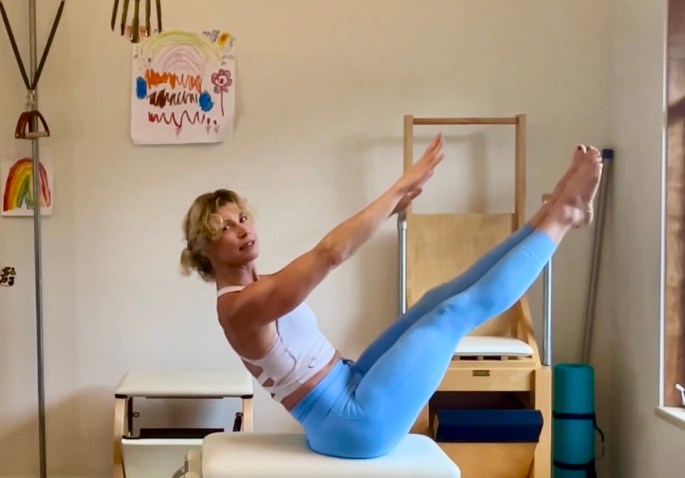
The teaser exercise is a strong and very challenging pilates exercise. Although this exercise requires a whole lot of BALANCED core strength, it also is essential that you have a flexible spine and open hips! There is a lot going on in this exercise, and it is not for everyone, especially if you have a boney tailbone…
For me personally, I have a very stiff low back and rolling up and down is tricky for me. If I move too fast, I will miss my whole lumbar spine on the way up and down. I have learned to slow down to feel more and take my time. Using my exhale will also help me cinch my waist more to help me better articulate.
This is just one scenario…There are many scenarios!! Whatever your issue/issues are – please remember it is not the destination of ‘sticking’ the posture or finding perfection – rather, it is the journey and process in how you work with your body with accepting what is first…there will always be another issue and always more work to do. Listening and paying attention to what is and making honest adjustments to support ourselves is always the best way forward…
Teaser. – Tall back or round back position?
Its actually both! There needs to be lift and length so when in your teaser position you are not dumping and collapsing in your lumbar and thoracic spine. That said there is a subtle c-curve. Meaning you will be behind your sit bones with the low back slightly rounded to support a posterior tilt especially if you are going to articulate your spine.
Careful that you are not collapsing in your lumbar spine… For example, if you are rounding too much in your low back, most cases you will be too round in your upper back and therefore not able to find your lift and length in your tall back and be able to widen your collar bone and open your chest! On the flip side, if you have too much extension and perhaps are positioned in front of your sits bones, most cases your ribs/chest will be pushing forward too much and you will not be able to connect well to your subtle c-curve and your power house muscles.
The bottom line is that there is always an element of TALL back. It is essential that you find your tall back first, especially before you round.
AND…
Remember to be gentle and patient with yourself! Pilates is not as easy as most people think. It’s sweaty hard work and always involves the WHOLE BODY. The practice of Pilates requires one to stay present and give a lot of effort! This attentiveness and hard work will increase your strength and overall well being. Any successful practice is generative:)
We get good at what we practice, not what we know:)
Check out my latest teaser tutorials on my YouTube channel!
1 – Teaser strap trick!
2 – Teaser on the reformer

