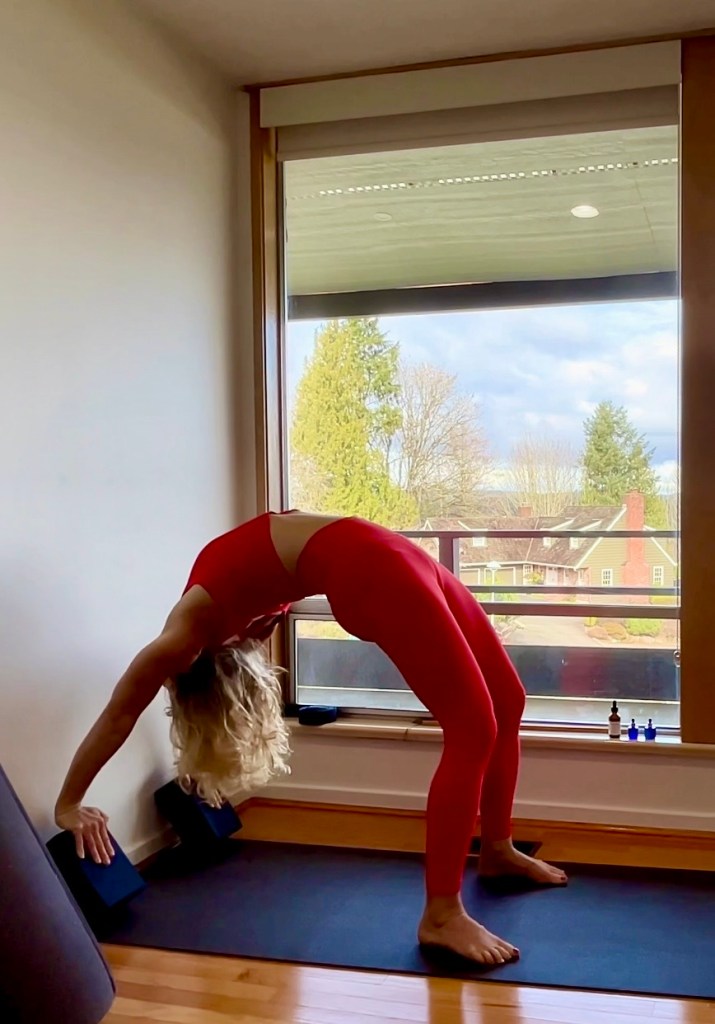
Learning something new is hard! The idea is always fun, but it does take some work!
Pontus and I just started taking Salsa lessons together. We have only had 3 lessons and understand that we have a ways to go… In our learning we are counting aloud to synchronize with the music and each other and trying to perfect every step we take as we move! The music doesn’t stop and that means we don’t either! The instructor moves fast and we are doing our best to keep up.:) With each lesson we gain more knowledge, awareness and have many shared laughs along the way!
I feel that learning salsa is similar to learning the Pilates. In salsa, there are several basic salsa steps that are precise and meant to be executed within a certain rhythm. In Pilates there are certain exercises to be done in order while maintaining a certain amount of rhythm and flow as well. Also, in salsa and Pilates transitions from one step and/or exercise to the next are just as important as the move/exercise itself!
One difference between Salsa and Pilates is the music. Music is intrinsic to salsa dancing, it helps with everything! In Pilates, although we do not have music to encourage us to stay at a reasonable tempo, it is still important to maintain a fluid rhythm. I feel that because there is no music in Pilates it is easier to stop, sometimes maybe for too long, in an effort to get the exercise/posture perfect!
It is given that you need rhythm to dance salsa, but it is also very true for Pilates. If you can master your transitions and flow you are more ‘advanced’ than someone who can perform the posture or exercise but does not understand how to flow in and out of it. Learning the rhythm and experiencing smoother transitions takes practice. That said, practice does not have to be perfect. Practice is practice. The practice is to pay attention as you move and breathe. To feel yourself and your surroundings (partner and music in salsa – apparatus in Pilates), all to make better connections with yourself and your surroundings.
My hope for all of you taking lessons is first that you are enjoying yourself or at least feel better when you leave:). I also hope you are gaining knowledge and more awareness of the practice and yourself. Last but not least, for those of you who have been practicing with me for a while, I hope you are discovering more rhythm and flow within the exercise and having fun while you work to find more connection in your body.
This is a quote from Darren Rhodes. I have witnessed his teaching from a far for 10+ years. I will be practicing with him for the first time in person this coming Spring 2026 at Joshua tree. I am so looking forward to finally meeting him in person.
I learned of Darren from my early years studying and practicing Anusara Yoga. He was a senior teacher and very well regarded in the Anusara community. He “walked the walk” in every aspect of living the principles of Yoga. He has a dry sense of humor and he is a very talented Yoga teacher.
In 2019, I encouraged Pontus to take Darren’s beginner yoga series on a platform called Glo as we were preparing to go to a yoga retreat in San Miguel for my 40th birthday wish back in 2019 with another one of my favorite Yoga teachers and friend, Desiree Rumbaugh.
Darren’s quote sums up what I try to inspire in all that I teach. Strength is nothing without flexibility just how being flexible will not serve us if we do not have a strong boundaries to keep us safe from over stretching.
What do you consider you need more of today – strength or flexibility?
tis the season to rush around. I hope you spend some time on yourself and invest in your health! If you have a chair, and I am sure you do, you can give yourself a full body workout. I personally love using a chair, especially on the days when all i feel like doing is sitting down in one and relaxing. However, I know that relaxing after I move, even for a little bit, will make my ability to relax so much better. It’s easy to let time pass by and get hung up on everything else but you, but don’t wait too long to take care of you:).
I will be offering a chair – functional fitness/yoga class in my home studio December 4th, 2025! Please reach out for more information.
This exercise is called ‘running’ on the reformer. Flipping the camera around you can see how this exercise reflects running, jogging, and/or walking off the reformer. I loved flipping the camera to highlight this exercise as it shows me standing tall in my body. It’s not always easy to stand tall especially if you are dealing with and or recovering from an injury. Believe me, I’ve been there! Regardless of your story, to practice Pilates, we need to include and honor all of our pieces even if things are not as they used to be, and not leave one piece behind.
Understanding how to connect and strengthen our pieces as a whole takes time and changes as we change. Listening, adapting, and continuing to love ourselves through all of our changes will be the best medicine to feel whole, time and time again. If you are stubborn like me, you may need to experience the ‘dark side’(read back in my blog to understand) for a while, until you decide to wake up and be more present!
Pilates is in the details and acknowledging all our piecesin the present moment so we can experience the whole and feel our power!!
Therefore, if you are interested in strengthening your ‘core muscles,’ understand that this involves your whole body. I have found that sometimes in ‘our’ efforts (myself included) to strengthen the ‘core muscles’ we sometimes neglect other parts of our body. Remember, Pilates is whole body integration. We need to include all of ‘our pieces’ in our practice and not forget or neglect any part! Pilates teaches us to initiate our movements from a stable, balanced center, and to never leave any part behind, meaning every piece of us is involved in the movement.
Take ‘running’ on the reformer for example, there is really so much to pay attention to! From the transition from one heel reaching under the foot bar to the next.
Here are some other things you need to consider…
1 – Are you connecting all of your toes on the foot bar or are your pinky toes missing?
2 – Are you pressing down into the foot bar with strength to feel and activate your hamstrings as you run?
3 – How is your pelvic alignment? are you tucking, arching? Hopefully you are in neutral!
4 – Are you able to connect the back of your rib cage, shoulder blades, back of skull in and up on the carriage?
5 – How is your neck alignment? hopefully neutral!
6 – Can you tone the back of your triceps to help you open the collar bone/chest more?
7 – Are you able to sustain your stability in your spine and pelvis as you lower and lift your heels with strength?
8 – Are you able to maintain your push/your strength as you resist the springs and actively under the foot bar one heel at a time? 9 – How are your knees? can you tone and lift your knee caps and quadriceps up with out hyperextending and locking your knees as you run?
10 – How about your breathing? How is your rhythm? can you expand your body on your inhales with out loosing your connections and deepen your powerhouse muscles on your exhales?
When you are learning, please be forgiving as it does take time! With steady practice and attention to your body and ALL your pieces its does start coming together, and you will start to step more and more into your POWER.
check out the song “step into you power” by Ray LaMontagne
The following are my class opportunities for the month of September!
On a trial basis I moving Pilates mat class to noon on Fridays and Yoga to 9am on Thursdays.
Pilates mat class – Fridays at noon
September 5,12,19,26
Yoga – Thursdays at 9am
September 11, 25
I am also excited to offer a new class format on Wednesdays at 12pm.
I am naming my new class – FUNctional fitness. You can expect to align your body and mind, strengthen your muscles and fortify your bones, and also mobilize and release shoulders, hips, and necks:). Optional use of some weights and resistance bands. See more in description below…
FUNctional fitness – Wednesdays at noon
September 10,17,24
What to expect with FUNCTIONAL FITNESS
–deep breaths standing with postural awareness. (5 min) Understand how to ‘stack our bodies” to find optimal alignment and connect to the relationship between our lungs/diaphragm and our pelvic floor.
-warm up (15/20 min)
-3 FUNctional exercises executed in sets of 10 done 3 times
these exercises will include movement that highlight
-hip hinge
-squats
-lunges
-twists
-move through sun salutations to integrate (you will learn surya A & surya B)(10/15 min)
-core/mobility work (10/15 min)
-3/4 various core exercises done in sets intermixed with 3/4 mobility exercises done in sets to to release after we strengthen.
example –
Core – forearm planks
mobility -cat/cows
or
Core – side planks
mobility – mermaid or gate(side body stretch)
or
Supine abdominal bracing with legs at table top
mobility – supple flowing bridges
-closing (5-10 min)
3/4 deep stretches to release hips/shoulders/neck
Please do not hesitate to reach out if you have questions.
Nothing lasts forever…This can be either good or bad depending on your own perspective experiences and impressions you have.
For me, I know now that resisting the inevitable is a waste of my time. “Time to be honest, Brooke” – I hear myself say often.
With my eldest daughter, Ginger, starting SDSU this fall, and my middle daughter, Coco, transitioning to high school, my husband and I have decided to move and not renew our current lease we have now in View ridge. This will be our 4th move since 2020! Fortunately, we will not be moving far from we are now, and I will have plenty of space for my equipment and will continue to teach privates and classes once set up! We will be moving in mid-June and therefore, I will be taking the month of June off. Our “new home” is in Inverness!
Moving again, has me reflecting on how change and transition is a constant reality. We all know that resisting our ever-evolving situations and changing physical landscape will only delay our essential and necessary job of letting go. This letting go is non-stop, old patterns, habits, diet changes, friendships, relationships, homes, even ideas will and should change. Ideally the ability to let go will help us welcome the present moment to live with more vitality and ease.
In our movement practices we can practice letting go by first paying attention and noticing what we are feeling and asking ourselves if what we are doing ‘feels right.’ Once we build that awareness, we can hopefully discern what is ‘not working’ and/or not connecting well. That knowledge and mindfulness can help us learn and discover ‘new’ ways to readjust and realign ourselves to make it ‘feel right’ for us at that particular moment (every day is different). Therefore, in my opinion, letting go of the old to welcome the present is active and not passive.
I will be practicing letting go a lot more these next few months and I hope I can inspire this same idea of letting go of the old to let in with the NEW to you as well.
Here is to paying attention to let go OVER AND OVER AND OVER AGAIN.
As we welcome November, I would like to offer my thanks to all of you who continue to support and practice with me at Le Bureau. I count my blessings often that I am able to do what I do and also have the opportunity to teach from my home.
It was not always this way. I started teaching Pilates in 2006 after completing a 600 hour +comprehensive classical Pilates training through Power Pilates, New York. Before this I taught school for 2 years after attaining my masters in teaching, at Seattle University.. I thought I was going to be a Kindergarten teacher as I chose to do my student teaching in a Kindergarten classroom at Our Lady of Lake catholic school, in Seattle, Washington. Well, that did not last long.
I married my husband, Pontus in 2003 and we moved to Iowa to begin his/our journey as he started Medical school. Although I started teaching as a substitute teacher in Iowa, I was drawn to movement and longed to teach exercise classes. On the side of teaching school, I become certified in personal training and acquired several other certifications to teach – about any class you can think of!
The practices of Yoga was my first fitness crush I discovered. There was a vibrant Yoga community in Des moines, Iowa and it became my ‘family’ away from home. I left Yoga classes feeling both energized but also calm. That said, the first 2 years in Iowa, I immersed myself in all things Anusara Yoga, a Hatha based practice that blends ‘heart’ themes.
In 2005, we moved to Ohio for a year for Pontus’s first year of medical rotations and I made the decision there not to renew my teaching license but instead to solely devote my time to learning about the body through many various fitness modalities. I worked as a personal trainer, taught fitness classes, including yoga, and also worked as a french tutor, and at a restaurant in the evenings. It’s amazing what you can do without Kids! It was here in Ohio, where I began my journey in Pilates. Out of curiosity to learn more and understand what Pilates was all about I enrolled myself in a weekend mat training through a Power Pilates studio in Sylvania, Ohio. After that weekend, I was hooked. Pilates made sense to me right away as I could grasp how it would benefit my body. I signed up for the comprehensive training not long after that. I had to let go of some of my classes I was teaching as well as the restaurant job to commit myself to the long training hours, but I enjoyed every second and I am so happy I chose this path.
After we left Ohio in 2006, we moved back to Iowa for a year, then moved to Redondo beach, CA for a year, and then to Salt lake city, Utah for 3 years before moving back to Seattle in 2012. I taught Pilates at ALL of these stops along the way. I also started the Pilates program at an Equinox in Manhattan Beach, CA in 2008 and also the Pilates program at Seattle Athletic Club(Northgate) in 2013. I have had made some amazing friends doing what I love to do over the years…
Fast forward to March 2016, I opened Le bureau Pilates in my home living room and I have been teaching from ‘home’ ever since. In October 2023, I started teaching group Pilates mat and Yoga classes and this has been a wonderful addition. The classes are a way to connect socially, physically and I love how it is becoming a small community. Thank you for trusting in me and being part of the Le Bureau community.
Please check out and enjoy my most resent Youtube tutorials and classes!
At the biological level, aging results from the impact of accumulation of wide variety of molecular and cellular damage over time. This leads to gradual decrease in physical and mental capacity….the diversity seen in older age is not random…. “ – World Health Organization
This past weekend, I took a course named, – “FUNtional Movement and SmartFLOW yoga” with my teacher Annie Carpenter and another SmartFLOW teacher and doctor of physical therapy; Brenna Barzennick, PT, DPT. The workshop explored the 7 functional movement patterns:
squat
hinge
push
pull
lunge
twist
gait
These functional movements are a part of our daily life and done well, these movements can support healthy aging. We explored how walking involves all of the 7 functional movements! Can you feel all the above actions when you are walking? Interesting fact – We learned how walking speed can predict the probability of functional decline in older adults. Keep walking with good attention to posture:)
During this training, we learned that the hub for human movement, as well as all the above functional movements is called the lumbar-pelvic Hip complex (LPHC). The “LPHC” consists of the lumbar spine, sacrum, pelvis, femurs(thigh bones), and includesof 35 muscles! Some of the larger muscles in the “LPHC” include the gluteal muscles, erector spinae group, hip flexors and extensors, hip adductors and abductors, spinal rotators, abdominal muscles, quadriceps, hamstrings, calf muscles, and latissimus dorsi.
The heart of this training was to communicate and show how complex these basic functional movements are as they involve an intricate and sometimes tangled part of the body. Furthermore, there needs to be both participation and coordination of all 35 muscles to support the movements in a balanced way.
This was a great workshop! I felt grateful for the knowledge that I already knew as the information was being lectured and discussed among the group of yogis. The Lumbar Pelvic Hip Complex is essentially the Pilates powerhouse:). More reason to practice Pilates!!
In this post I would like to highlight how the practice of Pilates, with a well trained teacher – me:), and other practices done well day-to-day, will support us in all we do, and help us age with strength and vitality.
Some examples of everyday activities:
squat/hinge- toileting, up and down out of a chair/car/tub, picking up items on the floor or gardening, putting on and tying shoes.
push – pushing a shopping cart/stroller/vacuum, sliding furniture, opening doors.
pull –opening doors/cabinets/drawers, pulling a suitcase, lifting body up from the floor.
lunge – stair climbing, walking up hill, kneeling gardening, picking something up from the floor, cleaning house.
twisting – reclining behind you, tolieting, cleaning body, turing to look while standing/standing/sitting, cooking/dishes.
gait – the human gait depends on a complex interplay of major parts of the nervous, musculoskeletal, and cardiorespiratory systems.
As all functional movement forces are generated and transmitted through this ares in our body.
What is Pilates really?
Pilates =contrology = art of control = mind controlling your muscles.
What do we want the muscles to do/be?
Pilates wants us to find balance and have a balanced support of our structure on all sides to promote optimal alignment.
Powerhouse muscles that support our pelvic center (LPHC) are key to finding balance:
As mentioned above; there are 35 muscles supporting this region in our body….the following are just some ‘larger player’…
inner & outer thighs
hamstrings
gluteals
quadriceps
erector spine muscles
transverse abdominals,
oblique abdominals
pelvic floor muscles
psoas muscle
The above powerhouse muscles is just our ‘lower powerhouse!’ There is a ‘secondary powerhouse’ (also known as the ‘secondary hub’) that focuses more on our shoulder girdle and upper body. However, the pelvis (primary and lower powerhouse) is our first priority as it connects our 2 halves – lower and upper bodies. If our pelvis and hips are out of alignment there will be consequences to both our lower and upper body, where as if we have an imbalance in our shoulder girdle or secondary powerhouse it is less likely that it will affect our lower body too.
consider Pilates movements with a functional movement framework!
If you are familiar with the Pilates method, you can probably agree that Pilates it is no joke! The practice of Pilates is hard work and requires the practitioner to be attentive in body and mind, start to finish! Body awareness, including better understanding and appreciation of the 7 functional movements, coordination, balance, steady breathing, strength, mobility, and patience are just some of the many benefits one can achieve with steady practice.
I have practiced and taught Pilates for close to 20 years and I have learned a lot about my body and other bodies that I have been fortunate to work with. Reflecting back, I realize that many of my issues and my clients difficulties are a result of pushing too hard and/or trying to perform a posture without considering or understanding the functional movement within that posture. Moreover, bodies change and sometimes we, including myself, forget to listen and connect to our changes big or small and want to do what we did yesterday, but forget to consider how we are in the present. I am grateful that I now have more awareness of the 7 functional movements, from my latest training, that will remind me to balance my ‘situations’ – pushes with my pulls, my spacious shoulders, and my blossom with my squeeze etc etc.
If you have read my blog in the past, you know some of my past ‘situations.’ I have been through a lot and have much more to share, but that is for another post:). My ‘problems’ did not happen overnight or from a few practices, they were poor habits and unconscious tendencies that I neglected in my life for years and those same habits were showing up in my Pilates practice! As my teacher Annie Carpenter likes to say, “How you do one thing is how you do everything.”
I was content to practice in ‘auto – pilot,’ for several years not just in Pilates but in life too. I caution when people associate Pilates only to a set of exercises or ‘systems’ in classical Pilates, for example. Pilates is much more than just exercises. Pilates is ‘whole’ mind-body exercise! The important thing is ‘HOW’ you do it. More importantly than the ‘how,’ is your ability to change your how when your body and life circumstances change. Like everything the only constant in life is change and so it is a constant practice to stay present to your whole body so that you can adapt your practice to your changing body.
Ruthless = Pilates (especially practiced on the mat)
Mat Pilates, especially is not an easy practice. Many individuals think that practicing Pilates on the mat would be easier than the reformer. In contrast, mat Pilates, is a whole lot harder to practice as you are without an apparatus that gives you boundaries, support and leverage. The mat offers no support except the floor and sometimes a wall and some minimal props such as a ball or magic circle. It takes a lot of awareness to understand how to connect our many pieces!! Mat Pilates is demanding and dare I say ruthless!
If you have taken my Pilates mat classes in the past you may already know that I start my classes with variations on functional movements to warm up the body before just starting down on the mat with the 100! I like to start with standing warmups. That said, there is nothing wrong with starting a mat Pilates class on the mat, in fact its a great way to connect to your body and feel your back and how it connects or doesn’t connect and sense how your arms and legs connect to your center. However, starting on the mat can also be deceiving, especially for the beginner, as you may forget to maintain your posture and alignment when you are on the ground and gravity is not weighing you down (as it is when you are standing). Often, I find myself saying – “try not to fall asleep!” I obverse especially legs and arms “falling asleep.” Remember in Pilates, the arms and legs are just extensions from our core/powerhouse, so there should be some effort in keeping those limbs “awake.” The ground offers support, but you still need to be aware and maintain your alignment as if you are still standing with your two feet on the ground!
Everyone needs to tweak their own body differently to find their best alignment but, generally speaking you want to encourage yourself to be alert in your body feeling the center of head, over center of throat, over center of heart, over center of pelvic floor, over center of knees, over center of ankles, with your 2 feet simultaneously grounded and arches lifted.
Pilates is an incredible method that can enhance your function in daily life!Change is inevitable, and you may have to adjust and adapt your practice with age, but having more awareness of the functional movements, will help us accept and be okay with changing our habits, to find more balance and ease.
I am grateful to my personal journey. All my challenges and hardships have only made me stronger. My practice of Pilates feels better and better the more I listen, accept and adapt my practice to my changing body.
Curious to try a Pilates mat class with me? Here is the general outline to how I structure my Mat Pilates classes –
5 minutes – “arrive in body” general body awareness and simple stretches to get us in our bodies
10 minutes – “functional warmup” some simple functional movements and mobility exercises for spine, shoulders and hips. Think squats, lunges, planks, cat/cows, shoulder circles, hip circles etc..
40 minutes – Pilates mat flow encouraging ideas from our functional movement warmup! I regularly apply the idea of a ‘squat’ to the various exercises in Pilates…this way we can remind ourselves that we are practicing this method to feel better and move better in life…not just perform in mat class!!
End standing in our ‘optimal posture’ to feel the efforts of our practice:)
* Starting in August 2024, I am excited to offer my Thursday mat classes at my new home/Le Bureau location. I will have a bigger space as well as more ‘wall room’
The song is one of my favorites!! It’s about being in LOVE, which is a constant compromise of BOTH standing your ground, and finding common ground.
Compromise is what I hope to inspire in my teaching and practice of both Yoga and Pilates… It’s important to “stand in our own body” and respect our own unique boundaries in our physical practice. It’s also valuable to remember that our bodies are ever changing and what may have been possible yesterday may or may not be not possible today. Having a flexible mindset, by listening to All of our bodies whispers is essential as we navigate through our lives and in our workouts. Maybe we could challenge ourselves more than we thought, or maybe our challenge is simply to negotiate different patterns of movement and be open and not be so rigid in our practice. There is always another way, idea, solution, point of view, side etc …to our stories and our body:) we are ever changing dynamic beautiful beings.
Recently I’ve stumbled upon a new practice that helps me navigate much more freely in my body and my life. It’s a breathing postural technique called ‘hypopressives.’ Although I am not an expert I have been practicing this technique for about 3 months now and I am a true devotee. It is a practice that serves my whole body. It does not take much time and is well worth my effort.
Those of you who read my blog, know my struggles and the pain I’ve endured in my right side body these past several years. My pain was very intense for a year after Pepper was born (almost 3 now). Although, I’m doing better, I still have work to do:). I have had an imbalance and injury in my right pelvis/hip/low back for years and chose to ignore this imbalance for several years as I was not experiencing pain. BIG MISTAKE. The past 3 years I have been doing more to help this imbalance and hopefully reduce my pain. Its a work in progress and I have found the postural breathing practice of hypopressives to compliment my practices of Yoga and Pilates to help me on my journey back to feeling at ease.
I learned about hypopressives after listening to a podcast, ‘The Vagina Coach’ that discusses all things women’s pelvic health. This podcast is a wealth of information and I would recommend that anyone who has a pelvis and especially to those of you who have had a vaginal delivery to have a listen! Hypopressives is a breathing practice performed using various simple postures. The practice creates a negative pressure in the pelvic cavity which helps the inner organs rise and return to a normal functioning position.
Here are several benefits I have experienced so far from hypopressives –
The breathing integrates postures and some gentle movement that has increased my ability to stay present with my breathwork. The outcomes i have desired from my breathing practice such as; connecting more to my parasympathetic nervous system, creating more inner space, helping my become more present etc etc has expanded and I feel the result! This practice is truly helping me SLOW down and reset my nervous system. This is huge as I have been stuck in my sympathetic nervous system for far too many years which I believe is the main source to why I have experienced so many challenges in my body.
The technique of hypopressives has also fine tuned my posture and helped me become more aware of ALL my sides and how they connect to my center. I believe my inner tissues (fascia) that connects all my internal organs had been stuck in a big tangled knot for years and this technique is helping me untangle and reorganize my inner body so I can feel at ease and stand tall without feeling as if I am being pulled down.
I have also experienced a deeper awareness of what it takes and what it should feel like when you “pull in and up”…which we do a lot of in Pilates.
Another great benefit is that its helping my internal abdomen release areas that have been stuck for a long time which has greatly helped my assimilation of food and my intra-abdominal pressure as a whole.
Most importantly this practice has helped me be my own observer. It’s not always pretty, but this self -awareness can shine a bright light on what we need to work on.
I hope reading this will ignite your curiosity to learn more and maybe practice hypopressives! It has been such a wonderful find in a dark time for me…maybe it could be wonderful for you too?
In summary, regardless if you choose to look up and learn more about hypopressives. I hope you can be grateful to all your unique problems and use them to be more curious to the ‘why’ and unlock and learn more about yourself. I have learned countless lessons that I wouldn’t have otherwise learned to the depths I understand them now if I have not gone through my challenges. I understand this attitude on life is not for everyone and I have often resisted this attitude initially too. When I do choose to be curious and look at the bigger picture of ‘why’ I learn so much and I am always grateful I dug a little deeper. It takes a lot of work to live out our best lives!
For me, teaching, practicing, and surrounding myself with like minded people who also understand that this lifestyle is a never ending compromise helps me stay on track.
Committing myself more to the ideas that everything is okay in moderation, a little bit goes a long way, “over doing” is just as toxic as “under-doing,” and lastly, there is never one right or one wrong way of doing anything! I call this my “goldilocks principle of Pilates and bread making, but it can be applied to all aspects of my life!
After depriving myself for years, I have been eating and baking sourdough bread for over a year (almost everyday and sometimes 2X/day)!
I do fondly remember loving bread and butter when I was young! However, I stayed away from eating ALL types of bread for several years for health concerns as I knew that gluten interfered with my body’s ability to optimally digest my food. Being hypo-thyroid, I have been coping with a sluggish digestion for most of my life after depleting my thyroid when I was a teenager.
As most of you may remember, during Covid, making sourdough bread was ‘on fire.’ Many people were proclaiming its benefits, one being better and improved digestion! I read that sourdough bread was easier to digest for many people as the acid in the bread from the active starter degrades the gluten. Furthermore, I learned that sourdough bread acts as a prebiotic fiber which means that the yeast in the bread help balance our bacteria in our guts! That is when my interest and ideas around eating bread (specifically sourdough) started to shift.
After learning about the health benefits I was curious if I could be okay eating sourdough bread? I was further inspired from a friend, Giovanni, who my family sees every year in Kona. When we are on the island, Giovanni makes us a fresh sourdough loaf every week we are there. I would eat his bread when we were on vacation and it was so good…I never felt that my digestion was an issue. I asked
him for a book I could use as a reference, (Flour, Water, Salt, Yeast, Ken Forkish) and I have been at “work” making bread since. Learning to bake my own sourdough bread has been challenging(especially in the beginning) , fun, and an ever evolving process! I have drawn many metaphors from my experience in baking sourdough to my Pilates practice.
Baking my bread I’ve learned that there is a distinction between under and over proofed bread. In other words, if I wait too long to bake my bread after the bulk fermentation stage my dough loses all structure, so it’s stretchy and slack when turned onto a work surface. The dough is also stickier than usual due to the lack of remaining gluten structure. Essentially, over-proofed means that the dough has run out of food. It’s exhausted. It’s been pushed past its limit and has no strength left. In really over-proofed dough the gluten strands will eventually break down, and the dough will collapse. This can happen before I put the loaf in the oven or it can collapse while its baking in the oven. There’s no strength left in the dough for it to maintain its shape anymore. I have felt this way in my body at times in the past after practicing Pilates and working too hard and/or for too long.
For instance, in Pilates, over working your body in any position for too long will fatigue and weaken your muscles and tissues, so it is necessary to keep moving! Remembering to move is nourishing and ‘feeds’ our bodies so we do not over work one position and break down our structures. Furthermore, continuous not rushed movement will help you stay light and bouyant on the inside, just how we want our sourdough baked bread! That said, continuing to move is easy to forget especially when you are trying to get it right! Maybe you are trying too hard?
In Pilates specifically, over tucking (tailbones) in all the exercises, even when that exercise/position would benefit more from a natural lumbar curve position of the spine is a very common position that is overdone and is held for too long. It can be challenging to know and feel if you are holding your tuck position and when to incorporate more of a neutral or ached position. Although there is a place for the “tuck,” it depends on many factors. For example, in what position is your body in? Are you moving? Where is your center of gravity? What is the rest of your body doing in that moment? As you see, there is much to consider, before you choose to tuck! Tucking our low spines needs more thoughtful attention, so there is balance between the front and back of our pelvis. Most importantly, please remember to keep moving and not stay in any one position for too long:).
A repetitive steady tendency to ‘tuck’ even when the exercise or position you are in (standing for instance), does not benefit from tucking will have consequences that will manifest in the rest of our body that are not necessarily the most healthy outcomes. Tucking promotes the upper spine to round and the front body/chest area to collapse. Furthermore, excessive tucking can tighten the front of our hips and groins causing imbalance in our muscles front to back. Our quads will turn on whereas our glutes and hamstrings will have trouble turning on which can result in the muscles in our glutes/hamstrings and low backs to tighten, weaken and shorten.
On the contrary, If you are in a round ‘C curve’ position, you must tuck to follow the natural movement of the spine and therefore, you must also ‘lift up’ in a round ‘C’ curve that continues out the crown of your head!
In most cases, I believe we over do the ‘tuck’ position unknowingly. For instance my teachers used to tell me to stop tucking and I had no idea I was doing it in the first place. Maybe this has happened to you too? Paying attention and checking in with ourselves and taking time to notice our inner sensations will teach us and give us more and more awareness to how our bodies should be feeling. Changing a habit is hard work, especially for us to change a habit we have been unaware of for maybe years!!! At first it may seem odd and not feel right, but remembering that everything, even this is a process, and finding balance and ease in our minds and bodies is always the goal!
In addition to not having the awareness of whether our tail is tucked or not, tucking our tail bones, could also symbolize our need to ‘protect ourselves.’ When we are insecure, and not living to our full potential of you we are inside, its easy to collapse into ourselves and feel lesser than. It can be challenging to stand tall when we do not even love and believe in ourselves. Just look at animals in nature, when they feel danger they curl up and ’protect’ themselves…
Getting back to my bread metaphor, dough that is under-proofed means that the yeast hasn’t produced enough carbon dioxide. The carbon dioxide gasses is what gives the dough its volume and openness. Therefore, for a beginner bread maker and Pilates practitioner who want to see results, it is necessary to have patience and trust in the process. With a regular consistent practice you should see results, but it does take time and practice.
You may be curious, how to know when the dough is over-proofed or under-proofed? This is similar to how to know if one is over or underworking some aspect in their Pilates practice! My answer to this is that you need to be flexible and consider many factors as you bake and or as you practice Pilates!
Specifically for Pilates, reminding ourselves to continue to MOVE the whole body is essential! In fact, Pilates could be described as one BIG exercise, or one movement that is constantly in transit. Furthermore, understanding that there is time for both, tucking and arching. Allowing ourselves to un-tuck and stand, sit, or lye in a ‘tall posture’ maintaining a healthy lumbar spine is as just as beneficial if not more than tucking our tails time to time to round our backs to enhance our powerhouse. Lastly, learning the Pilates method is individual and no set of exercises and or body positions will be ‘right’ for every body. At times depending on the body and the transition at hand, we may need to enhance more round or extension, but never will we stay too long, as this is what creates tension! Life is always in transition as our bodies must be as well.
For sourdough bread baking…Its not as simple as just following a recipe and going off the recipe baking times and various steps. Fortunately, a seasoned baker has baked enough bread that they know what to look for and waits just enough for the bread/dough to tell them when it’s ready! Its worth the effort to pay attention and listen to your body and watch your bread! As you bake bread, and train your body remember that under and over-proofing dough and under or over working your body just happens, even to the best bakers and best practitioners.:)
I truly believe we all are looking for things, people and situations that bring a sense of balance and/or middle ground to our lives. The same is true in our Pilates practice! Through my personal experience with baking bread and practicing Pilates I have had several occurrences when some incident/challenge positioned me to “act” in extremes….maybe starting at one end of a spectrum and then to the other side, and them back again and so forth! Finding middle ground and balance is work in progress and something I strive for more and more in all aspects of my life.
With everything, the more you practice the “goldilocks principle” in your body you will become more curious, sensitive, and open to changing any habits are not serving you. This practice to keep moving while staying present to myself, and live by the “goldilocks” principle is well worth the work!
Here are some things to consider next time you go on your mat:
*It’s important to have reverence for your lumbar spine and remember the goldilocks principle!
Consider finding more balance between the front and back of your spine! The front and back of your spine both need to be engaged and turned on to a degree as well. I find that sometimes there tends to be a misconception, that to achieve a strong core you should feel the burn on the abdominals and sometimes in this process of only paying attention to the “burn” sensation, one may forget and neglect other aspects of their body, in particular, their back body! In fact the low back should stay long, spacious and also participating along with the abdominals. This is difficult to understand as we do not see our and or notice our backs when we are focused on strengthening our abdominals on your font body. Therefore, as we engage our stomach muscles to our backs we need to remember to engage and strengthen our backs too! An example of this would be executing a plank, as the front and back bodies are working together to achieve a strong plank position!
When lying supine and you’re especially not “rolling/rounding” in an exercise, such as the hundred, leg circles, series of 5, etc etc…remember to root your tail bone. Not only will rooting our tail bone help us un-tuck and stay long and lifted in our low backs we will also establish a clear focal point to lengthen and grow out of, achieving a delicious counter stretch we all crave. From our pelvic center we will stretch our lower body in optosition to our spines growing and lengthening out the roof of our mouths! This action is easy to forget. I see it in myself, and others more than I want to admit.
Rooting our tail bones is essential even if your upper spines are lifted and curling off the mat, your tail should stay anchored to facilitate more of a two way stretch. Note that in even this position with your upper body lifting off the mat, you should not be tucking!! Instead you should be working hard to deepen your low abdominals in and up to support your low spines. Depending on the body, some spines will be on the mat and some may be imprinted…everyone is different. I find that when people finally understand and commit to rooting their tail bones, they notice that their low backs are no longer imprinted in the mat. They think however that they have to have their low backs on the mat to strengthen and work their low abdominals, so they will unroot their tail bones, “tuck,” just so they can feel their low backs imprinted! This is not healthy for your low backs and will cause more damage down the road if this pattern is repeated over and over as you are neglecting your back bodies and over working the front of your body in a shortened and more compressed state.
If you feel that you are somebody who easily uproots their tail bone, my advice would be to focus on keeping and creating more space in the front of your hips and more space in your front spine in-between your pelvis and your ribs! This is something we want. The challenging part is keeping this space and length in our bones as we execute exercises. Its definitely not easy, but this is where the work comes in. For example , we need to ‘scoop’ with out shortening and we need to deepen our low abdominals to our spines without dumping and compressing. Again, have reverence for your low spine and sense the “goldilocks principle” in your whole body where your front and back bodies equally participating in the workout.
When you are seated and moving in an exercise you may move in between your sit bones and tailbone depending what shape of the spine you are trying to achieve… if you are tall you should sit on or slightly in front of your sit bones and most definitely in front of your tail bone. If you are rounding your spine you should pay attention to sitting slightly behind your sit bones and in some positions, behind your tail bone, but be careful not to collapse in your upper spine, remembering to find length and space in the round!