optimal physical alignment inspires inner body health, function, & flow

Dear friends,

I have recently attended a weekend Yoga workshop with Annie Carpenter in Seattle at Mother Yoga in the international district.  The workshop attracted many local teachers and I am always so inspired when teachers continue to show up and keep learning. I am grateful that Annie Carpenter continues to do the work herself and shares the knowledge she’s attained over her many years of teaching.  She is constantly learning and growing in her own practice.  She has had to overcome her unique challenges in her own body and generously shares her experience which encourages her students to grow in themselves and give that back to their students.

Annie teaches her students how to find neutral pelvis, using the 3 planes of movement (Sagittal, coronal, transverse).  It is a simple and effective  way to learn and establish neutral pelvis, which is, in my opinion, so important to practice for whole body health and function.  Of course once you establish this awareness of neutral pelvis and what it is and is not – it takes attention and practice to sustain it as one unravels possibly unconscious poor habits and holding patterns.  

This is the practice!  Paying attention to our posture to enhance our inner connections, circulation, and function in our day-to-day activities.  Our bones and structures directly affect our muscles, fascia and inner organs inside to function and work properly! 

I believe pelvic placement and awareness is everything as it is the center of our body and affects our whole system. Our pelvis not only connects to our upper body through our spine, but it also connects to our lower body through our femur bones.  The pelvis also has 2 sides – a right pelvic half and a left pelvic half and that is significant!!   

I made a short video/practice on my YouTube channel if you are interested understanding neutral pelvis where I use the 3 planes of movement.  I have also started incorporating this in my Thursday mat classes:)

If you are reading this, you may already know that it is Annie’s focus on the pelvis that drew me to her and her teachings.  Annie emphasizes how our femur bones drive pelvic placement, so when we work through the 3 planes of movement to balance and neutralize our pelvis, it is essential that our feet and our legs are integrating into our hip sockets though out our movements too .

As you can imagine, if we are not paying attention, the pelvis, could take many shapes and forms! It could be a combination of either tucked, arched, hiked up on one side and/or rotated too much in one direction. If you are suffering pain or discomfort in your lower back and/or hips, a misaligned, unbalanced pelvis could be to blame.

To clarify, the pelvis is going to move when we move as it is part of the spine and the legs, so its normal for the pelvis to move in and out of a neutral posture. For example, every time we walk we move in and out of tuck/tilt, hike up and down, and we rotate side to side. However, problems arise when the pelvis gets stuck in an unbalanced position and cannot unstick.

When the pelvis is imbalanced, it can directly affect the health and well-being of our pelvic floor. The following are some interesting facts on our pelvic floor to better understand why our physical alignment is so crucial.

1 – the pelvic floor is the base and the foundation of our core.

Its a group of muscles that sit at the very bottom of our pelvis, like a sling or hammock.  It supports everything above it – bladder, bowel, hips and spine.

2 – the pelvic floor has openings.

For example – Women – 3 

  • urethra
  • Vagina
  • Rectum

These muscles need to open and close at the right times to keep everything moving and working smoothly.

3 – the pelvic floor muscles should lift and lower with our breathing which is why taking deep breaths is soooo very important.

It’s a dynamic!  Think of an elevator.  When you breath in the elevator goes down and when you breath out the elevator goes up!  A healthy pelvic floor should be able to move easility depending what your body is doing!  BREATHE

4 – your pelvic floor is 70% fascia and 30% muscle. 

Fascia is a stretchy connective tissue that connects our whole body like a web.  It relies on the muscles to give it support, as it cannot contact on its own!  When the muscles are not doing its job and the pelvis is out of alignment for whatever reason, the fascia can over stretch and as consequence can be weakened.  When the fascia is overstretched it can make matters worse as the pelvic floor muscles try to work harder..it can be a vicious cycle. When this cycle continues, the pelvic floor becomes hypertonic and unable to relax as it is working overtime to compensate for the stretched out fascia. This tightness overtime leads to weakness as our pelvic floor never gets a chance to relax! This can lead to damage and several pelvic floor issues – muscle spasms, leaking, straining, inability to empty, prolapse.  

I first hand understand this dynamic as I have experienced many of these consequences. Although I did not welcome any of them, they have made me a better teacher and someone that understands the importance of body alignment, especially the value in neutral pelvis!
COMPROMISE

“Let’s Call the Whole Thing Off”

by Ella Fitzgerald and Louis Armstrong

… Things have come to a pretty pass

Our romance is growing flat

For you like this and the other

While I go for this and that

Goodness knows what the end will be

Oh, I don’t know where I’m at

It looks as if we two will never be one

Something must be done

… You say either, I say either

You say neither and I say neither

Either, either, neither, neither

Let’s call the whole thing off, yes

… You like potato and I like potato

You like tomato and I like tomato

Potato, potahto, tomato, tomahto

Let’s call the whole thing off

… But oh, if we call the whole thing off

Then we must part

And oh, if we ever part

Then that might break my heart

… So if you like pyjamas and I like pyjahmas

I’ll wear pyjamas and give up pyajahmas

For we know, we need each other

So we better call the calling off, off

Oh, let’s call the whole thing off, yes

… You say laughter and I say larfter

You say after and I say arfter

Laughter, larfter, after, arfter

Let’s call the whole thing off

You like vanilla and I like vanella

You saspiralla and I saspirella

Vanilla, vanella, chocolate, strawberry

Let’s call the whole thing off

… But oh, if we call the whole thing off

Then we must part

And, oh, if we ever part

Then that might break my heart

… So if you go for oysters and I go for ersters

I’ll order oysters and cancel the ersters

For we know, we need each other

So we better call the calling off, off

Let’s call the whole thing off

… Yes, you say either and you say either

You say neither and you say neither

Either, either, a-neither, a-neither

Let’s call the whole thing off, oh, yes

You like potato and you like potahto

You like tomato and you like tomahto

Potato, potahto, tomato, tomahto

Let’s call the whole thing off

… But oh, if we call the whole thing off

Then we must part

And oh, if we ever part

Then that might break my heart

… So if you like pyjamas (I like pyjahmas)

I’ll wear pyjamas (you got pyjamas)

For we know, we need each other

So we better call the calling off, off

Let’s call the whole thing off

Let’s call the whole thing off (yes)

 The song is one of my favorites!!  It’s about being in LOVE, which is a constant compromise of BOTH standing your ground, and finding common ground.  

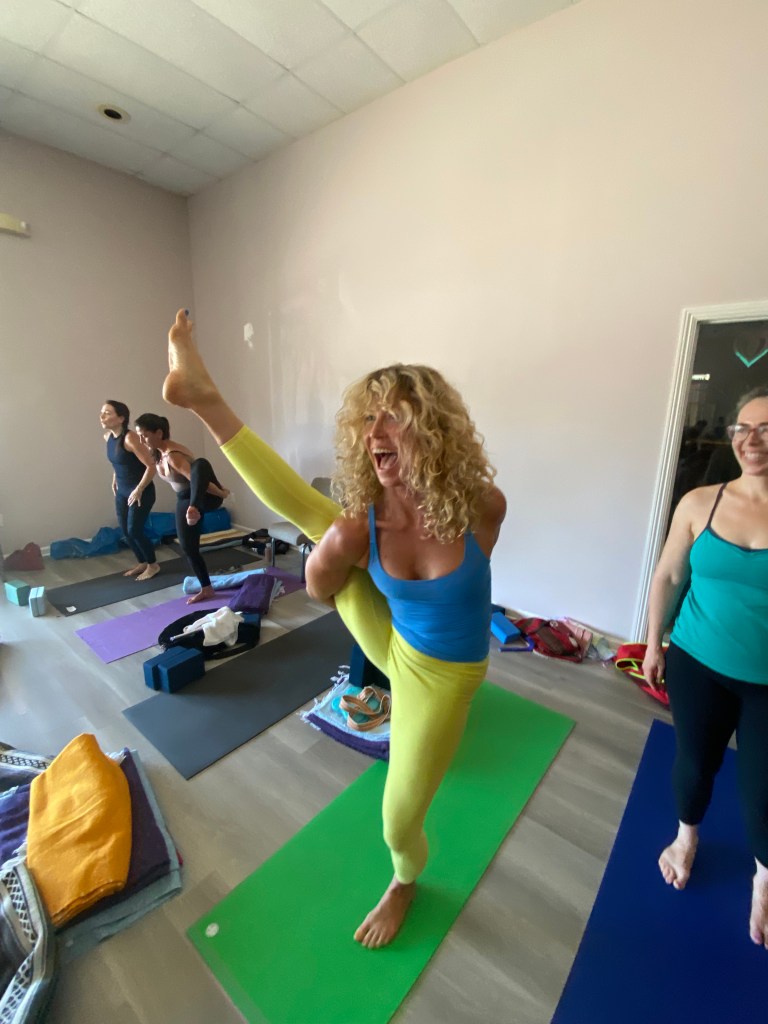
Compromise is what I hope to inspire in my teaching and practice of both Yoga and Pilates…  It’s important to “stand in our own body” and respect our own unique boundaries in our physical practice.  It’s also valuable to remember that our bodies are ever changing and what may have been possible yesterday may or may not be not possible today.   Having a flexible mindset,  by listening to All of our bodies whispers is essential as we navigate through our lives and in our workouts.  Maybe we could challenge ourselves more than we thought, or maybe our challenge is simply to negotiate different patterns of movement and be open and not be so rigid in our practice.  There is always another way, idea, solution, point of view, side  etc …to our stories and our body:)  we are ever changing dynamic beautiful beings.  

Recently I’ve stumbled upon a new practice that helps me navigate much more freely in my body and my life.  It’s a breathing postural technique called ‘hypopressives.’  Although I am not an expert I have been practicing this technique for about 3 months now and I am a true devotee.   It is a practice that serves my whole body.  It does not take much time and is well worth my effort.

Those of you who read my blog, know my struggles and the pain I’ve endured in my right side body these past several years.  My pain was very intense for a year after Pepper was born (almost 3 now).  Although, I’m doing better, I still have work to do:).  I have had an imbalance and injury in my right pelvis/hip/low back for years and chose to ignore this imbalance  for several years as I was not experiencing pain.  BIG MISTAKE.    The past 3 years I have been doing more to help this imbalance and hopefully reduce my pain.  Its a work in progress and I have found the postural breathing practice of  hypopressives to compliment my practices of Yoga and Pilates to help me on my journey back to feeling at ease. 

I learned about hypopressives after listening to a podcast, ‘The Vagina Coach’ that discusses all things women’s pelvic health.  This podcast is a wealth of information and I would recommend that anyone who has a pelvis and especially to those of you who have had a vaginal delivery to have a listen!   Hypopressives is a breathing practice performed using various simple postures. The practice creates a negative pressure in the pelvic cavity which helps the inner organs rise and return to a normal functioning position. 

Here are several benefits I have experienced so far from hypopressives – 

  • The breathing integrates postures and some gentle movement that has    increased my ability to stay present with my breathwork.  The outcomes i have desired from my breathing practice such as; connecting more to my parasympathetic nervous system, creating more inner space, helping my become more present  etc etc has expanded and I feel the result! This practice is truly helping me SLOW down and reset my nervous system.  This is huge as I have been stuck in my sympathetic nervous system for far too many years which I believe is the main source to why I have experienced so many challenges in my body.
  • The technique of hypopressives has also fine tuned my posture and helped me become more aware of ALL my sides and how they connect to my center.  I believe my inner tissues (fascia) that connects all my internal organs had been stuck in a big tangled knot for years and this technique is helping me untangle and reorganize my inner body so I can feel at ease and stand tall without feeling as if I am being pulled down.  
  • I have also experienced a  deeper awareness of what it takes and what it should feel like when you “pull in and up”…which we do a lot of in Pilates.  
  • Another great benefit is that its helping my internal abdomen release areas that have been stuck for a long time which has greatly helped my assimilation of food and my intra-abdominal pressure as a whole.  

Most importantly this practice has helped me be my own observer.  It’s not always pretty, but this self -awareness can shine a bright light on what we need to work on.

I hope reading this will ignite your curiosity to learn more and maybe practice hypopressives!  It has been such a wonderful find in a dark time for me…maybe it could be wonderful for you too?

In summary, regardless if you choose to look up and learn more about hypopressives.   I hope you can be grateful  to all your unique problems and use them to be more curious to the ‘why’ and unlock and learn more about yourself.  I have learned countless lessons that I wouldn’t have otherwise learned to the depths I understand them now if I have not gone through my challenges.  I understand this attitude on life is not for everyone and I have often resisted this attitude initially too.   When I do choose to be curious and look at the bigger picture of ‘why’ I learn so much and I am always grateful I dug a little deeper.  It takes a lot of work to live out our best lives!  

For me, teaching, practicing, and surrounding myself with like minded people who also understand that this lifestyle is a never ending compromise helps me stay on track.

Bisoux,

Brooke