Unlock your hips to find more balance

I believe that we are as strong in our core as much as we are open in our hips.  To find a beautiful posture and superior balance in our bodies, we need both. For, if our hips are stuck tight and bound with no space we will not be able to access and use our strength in our daily functional movements.

2 tools to help you unwind tension in your hips is the hip hinge and finding a neutral pelvis.

When you perform a hip hinge -notice if your back rounds and bends when you hinge. You should instead aim to keep your back long and lifted.    It seems simple to hinge the hips but our hips can hold a lot of tension and sometimes this simple exercise is harder that you may think.

A neutral pelvis is a position where the pelvis is neither too arched, nor too tucked.  For me I sense balance on all my sides of my pelvis and one side is not working more than the other.  

Understanding and executing these 2 actions in our movements will encourage more space and balance in our hips and will help us engage the bottom of our lower powerhouse (aka pelvic floor muscles) that are easily neglected in today’s modern world of sitting too much. 

One scenario of why you may experience a lot of muscular tension in your hips and groin area is possibly because your thigh bones live more forward toward your quadriceps, instead of back toward your hamstrings.  If this is your reality, welcome to the club!  This is not uncommon.  Being more quadricep dominant, usually indicates imbalanced pelvic floor muscles, and weaker hamstrings and gluteal muscles.  When there is an imbalance between front and back bodies, poor balance, especially on one leg is usually a consequence.  Poor balance happens when you are not able to integrate your body as a whole and connect to your midline.  You may still have lots of strength but it is not balanced in your body side to side, front to back, and upper to lower body through your pelvic center!   

To work on opening your hips to connect your upper and lower bodies better and enhance your balance, I recommend practicing your hip hinge, as well as being mindful to connect to a neutral pelvis!  

As you hinge in your hips you can concentrate on drawing the root of your thigh bones back into the back of your hip socket.  When you do  that you should feel your quadriceps soften and find more connection of your gluteals and hamstring muscles.  Maintaining a neutral pelvis where you are not tucking nor arching can help you integrate your whole body as one piece and feel connected on all your sides.  Notice when you stand….do you feel more quadriceps or more hamstrings?  Can you stand and notice both sides?  

I have made a short video on my YOUtube channel to help you unlock your hips, (especially if you are, one of the many, who live more in your quadriceps than your hamstrings)! I demonstrate a hip hinge lying supine, and show you what to watch out for when sustaining a neutral pelvis!   I hope this will be useful for you.

The 3 stretches I demonstrate are called, reclined hand to big toe pose – Supta padangustasana 1,2,3

These 3 stretches, done with neutral pelvis, release the muscles surrounding your pelvis to unlock your hips and therefore create better balance! 

Once you think you found a neutral pelvis, its’ interesting what happens when you move.  remember the pelvis is connected to your lower and upper body , so it is easily pulled around all day!  

It takes time and patience to notice your pelvic tendencies.  Not an easy thing to do if you are always in a hurry.:)

Finding neutral in my pelvis still a mindful practice for me.  Neutral pelvis serves me well in all my activities.  I feel grounded and integrated head to toe and more connected and balanced front to back and side to side.  

Love,

Brooke
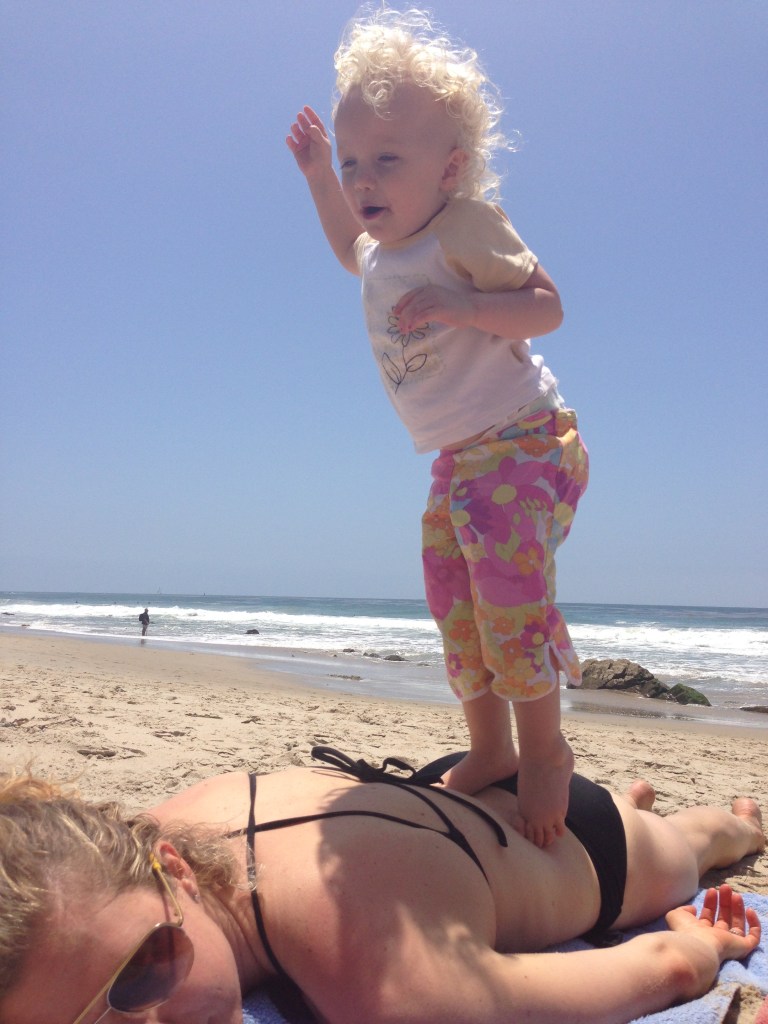
“Mother tucker”

A ‘mother tucker’ is someone who is stuck in a ‘tucked’ position.

-Brooke Oberg

Yes!  I was a “mother tucker” for many years and still do catch myself tucking when it is not appropriate!  If you have read any of my previous posts you already know this and probably have a good idea why too.:)

Not to say that ALL tucking is bad.  In fact, some exercises you need to tuck to support the round back position.  However, its important that when you do ‘tuck’ you are aware of how it is affecting your sacrum. 

Our sacrum is a vulnerable area in our body and it’s worth our efforts to pay attention to how we integrate this area  in our movements  so that we can find more optimal alignment patterns and feel more freedom and move with more ease in our whole body.  Remember its not all about what we do, instead its important HOW we do it and how we are incorporating our ‘whole body’ in our actions!

I hope the following will bring more awareness to your sacrum.  I hope this awareness will convey how sacred our sacrum is and helps us consider how we manipulate this area in our body.

The sacrum in human anatomy is a large triangular  bone at the base of the spine.  It is situated at the upper back part of the pelvis, and connects our 2 pelvic halves(hips).  The upper part of our sacrum connects to our lumbar spine and the base of our sacrum connects to the tailbone/(coccyx).  Thus the sacrum connects the upper and lower body(heaven and earth); all our bodies weight pass through this location.  Lastly, it is a concave shape as it is curved upon itself and the base of the sacrum, the broadest and uppermost part, is tilted forward.  Meaning for optimal standing and seated posture, the low back/sacrum should be in extension – ‘in and up’ as opposed to being stuck in a tucked position.  

Some other interesting things about the sacrum…

-The Romans said this part of the body was “sacred” or “holy” as it was used in sacrificial rites in protecting the genitalia (which in ancient times were considered sacred).  In yogic spiritual anatomy, the sacrum is the home of Kundalini, a feminine – serphant like energy that sits coiled at the base of the spine.

-The sacrum is known to be the keystone of our pelvic bowl!  It is in the sacrum, where life is created, just think about that!!  Also, many of our vital spinal nerves start  in the sacrum and the sacrum is one end of our nervous system that connects all the way up to our brain via the Vagus Nerve.

-Too add to this complex area, the sacrum is the location of 1 of our 7 energy centers of our body (svadhisthana chakra).   This location of our sacrum governs our sensuality, sexual intimacy, our ability to give and receive pleasure, and simply be creative  and in the ‘flow’ of our own life.  When this area of our body is blocked or stuck for any reason, perhaps being to sedentary, injured, feeling not safe, etc, or in perhaps tucking too much….it can create many imbalances, upset our ability to connect to our parasympathetic nervous system, and create feelings of isolation, low libido, and detachment.

Now that we have more knowledge of the sacrum:

When do we tuck?

As I mentioned earlier, tucking is inappropriate and unnecessary most of the time unless you are integrating your whole spine and posture into the tuck; aka, round position ….think rollup, rolling like a ball, etc.  Or perhaps you are mobilizing, creating length and space for your lower back with cat/cows or rolling bridges.  With more fluid mobilizing movements such as cat/cow, remember that you are not holding the tuck for very long.

How to integrate the sacrum so it stays open and spacious in the tuck?

Tucking is useful to do in an effort to stretch and open our low back.  However, with everything, it is easy to overdo the tuck and  instead of creating more width and space, its easy to clench our low back/buttocks instead.  In order to keep the sacrum spacious it is necessary to check in with your low back and notice your sensations.  Here are some tips to help you with your tuck:

1 – when you are tucking and your low back in rounding, your whole spine needs to be in the round back position!!  That means you are looking at your abdominals with your eyes and your scapula is brooding wide across your back and the back ribs are also fanning open to create space for your front spine and abdominals to deepen into.

2 – root your femur bones (thigh bones).  

If our thigh bones are stuck forward this can pull on our low back muscles making it easier to collapse and yes – tuck!  How to check if your things bones are forward – feel your groins if they are hard, usually your femurs are too far forward and you need to integrate some hip stretches that open up the back of your hip capsule so your femurs can glide back in the socket.  Other times, you just need to check in with your lower body – if your knees hyperextend when you are standing, you are most likely a tucker.  My advice for you is to soften your knees, ground and spread your feet wide in an even portion and stack your posture more appropriately.  Think – center of ankle below center of knees, below center of pelvic bowl, keeping your knees soft of course!!

3 – energize your lower body.  Remember your legs/feet are an extension of your powerhouse core, hip/pelvis/sacrum center.  So its valuable to integrate these parts with full awareness in your movements.  Careful not to let your limbs just hang and be an ornament…you want your limbs participating as much as your core.   To do this, you need to hug your midline or energetically draw your shin bones in and your thigh bones apart to energetically open up your sacrum low back.. think of a see saw, lower limbs hug in to your middle to simultaneously broaden and open your upper thighs hips/low back.

The bottom line is that it is a good idea to pay attention to your posture and how it is affecting your sacrum and vice versa.  When standing, sitting, and exercising etc, check in with yourself.  Most of the time, you will want to keep your low back long, lifted and spacious in its’ lumbar/natural lordotic curve, which is essential to balance your spine and posture.  When you need to tuck, remember that 1 – the whole body needs to be participating from your feet to your skull in your round, 2 – Energize your lower body by hugging your midline, and 3 – root your femurs bones!   When in doubt, know that you never want the low back bones to push out and back in collapse!  This happens all too easily in a tucked position. This congestion in our low back hips creates pressure and feelings of stickiness in our pelvis/hips/low back.

I hope reading this helped bring more awareness to your sacred bone, sacrum.  Its a vulnerable area in our body that is easily neglected.  Try to recognize this sacred bone, the sacrum.  Maybe, also take a moment to reflect on the people and things in your life that are sacred to you.  The things and people that usually matter most to us can also be neglected and taken forgranted.  Bringing our attention to the sacred within and around us will hopefully uplift us and help create more inner lift and peace.

I have posted some recent videos on my you tube channel that are a good complement to this idea.

I hope you check them out! https://www.youtube.com/channel/UClUKWMPAcZ-4jOcPYY_F8NQ  

Aloha and Mele Kalikimaka